

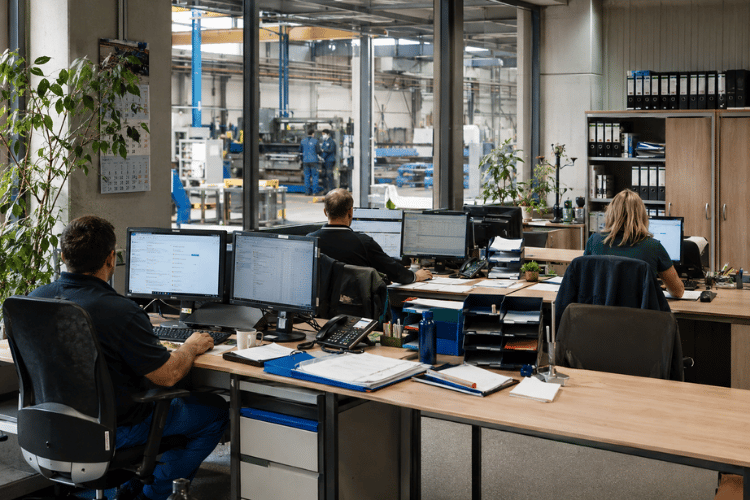
Measuring Dust Levels in the Workplace
Dust exposure in workshops, production facilities, and storage areas occurs, for example, during grinding, drilling, sawing, transferring materials, packaging, or cleaning. Vehicles and the movement of materials can also stir up settled dust.
Particle concentrations can rise sharply and then drop again within a short period of time. A single measurement therefore reflects only a limited period of time. Continuous dust monitoring complements workplace measurements by revealing when exposure occurs, how long it lasts, and whether it recurs regularly.
The air-Q allows for the continuous monitoring and analysis of PM1, PM2.5, and PM10 particulate matter levels. This makes it possible to identify dust spikes, pollution patterns, and changes resulting from operational measures.
The air-Q is suitable for preliminary monitoring of fine particulate matter levels. However, it does not replace standard-compliant workplace measurements, as A- and E-dust must be determined using appropriate methods for the assessment of occupational exposure limits.
Why Continuous Monitoring Is Useful
Dust exposure depends on work activities, machinery, materials, and ventilation conditions. A single measurement may appear normal, even though high exposure peaks occur regularly during certain work steps.
Continuous measurement data helps identify:
- when fine particulate matter pollution occurs,
- how long they last,
- whether certain processes or activities are the cause,
- whether protective measures such as exhaust systems or changes to procedures are effective.
Monitoring is not a substitute for workplace measurements, but it can help identify periods and areas of concern more precisely for further investigation.
A-dust, E-dust, and PM levels are not equivalent
In occupational safety, a distinction is made between inhalable dust (E-dust) and respirable dust (A-dust). E-dust consists of particles that can be inhaled through the mouth and nose, while A-dust can reach the alveoli.
The values PM1, PM2.5, and PM10, which are commonly used in general air quality measurements, are defined differently. Therefore, they should not be equated with A- or E-dust or converted into one another.
Dust Exposure Limits in the Workplace
For poorly soluble or insoluble dusts that are not otherwise regulated, TRGS 900 specifies the following general dust exposure limits:
- 1.25 mg/m³ for the respirable A-dust fraction
- 10 mg/m³ for the inhalable E-dust fraction
Stricter requirements may apply to dusts with specific health hazards, such as dusts containing quartz, wood dust, or carcinogenic components.
A low PM concentration therefore does not automatically mean that there is no risk.
How does the air-Q measure particulates?
The particulate matter sensor in the air-Q operates on an optical measurement principle. The particles drawn in scatter light onto a detector. Particle sizes are calculated from the measurement signals, and the mass concentrations for PM1, PM2.5, and PM10 are derived from these.
This method allows for rapid and continuous monitoring of particle load. Unlike gravimetric measurement, however, the dust mass is not weighed directly.
Measurement readings can be affected by particle characteristics such as shape, density, or color, as well as by high humidity, very high dust concentrations, or deposits in the sensor. In applications with high dust levels, the measurement range, device condition, and positioning should therefore be checked regularly.
An air quality monitor thus serves as an indicator of changes in particulate matter levels, not as a legally binding assessment of personal exposure to particulate matter.
Identifying Sources of Dust and Related Processes
The advantage of continuous monitoring lies in the connection between measured values and operational processes. If the particulates values rise regularly during certain activities, it is easier to identify possible causes.
It is helpful to document the following:
- dusty activities,
- machines and materials used,
- Ventilation and exhaust systems,
- Cleaning work,
- Vehicle and material movements,
- Maintenance or malfunctions.
This allows companies to better understand when dust pollution occurs and which processes are associated with it.
Review protective measures
If extraction systems are optimized, machines are enclosed, or work processes are modified, the air-Q can make changes in particle levels visible.
For example, the following can be checked:
- whether dust peaks are lower,
- whether the duration of the load changes,
- whether the measures are effective even at higher capacity levels.
To ensure meaningful comparisons, measurement conditions—such as equipment position, activity, and material—should remain as consistent as possible. Whether a protective measure complies with the requirements of hazardous substances legislation must be assessed by an expert.
Typical Applications
Continuous particulate matter monitoring with the air-Q is particularly well-suited for areas where particles are regularly released or stirred up, such as:
- Workshops and Production Areas
- Production and Assembly Halls
- Warehouse and Logistics Areas
- Filling and Packaging Systems
- Vocational Training Workshops
- Areas Involving Material Processing
- Workplaces with powdered substances
- Areas that require frequent cleaning
In large halls or halls with different uses, a single measurement point cannot cover all areas. Using multiple devices can help identify spatial differences and possible propagation paths.
Using Continuous Data in Occupational Safety
The air-Q complements professional workplace measurements by providing continuous insight into changes in particle levels over time.
This enables companies to:
- Identify dust events,
- Identify the sources of stress,
- Monitor processes over an extended period of time,
- Compare protective measures,
- plan further investigations in a more targeted manner.
The air-Q is therefore a tool for the early detection of changes and abnormalities, but it is not a device for measuring threshold values.
Conclusion
Dust exposure levels vary in day-to-day work depending on the task, process, and environment. Individual measurements are important for technical assessment, but they only reflect a limited period of time.
The air-Q visualizes the trends over time for PM1, PM2.5, and PM10 and helps track dust spikes, recurring patterns, and changes following corrective measures.
The air-Q cannot replace standard-compliant A or E dust measurements or the assessment of occupational exposure limits. However, as a supplementary monitoring system, it provides insight into trends in fine dust levels in dust-intensive work areas.


.jpg)


