

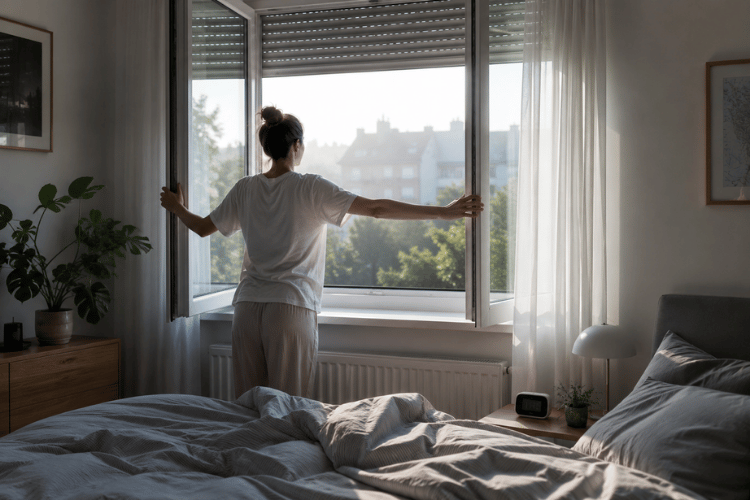
On hot summer days, many people look forward to nighttime. Lower temperatures are supposed to help them relax and finally make their overheated homes comfortable again. But especially in cities, this cooling effect often fails to materialize. Even with the windows open, the bedroom still feels warm in the morning, and getting a restful night’s sleep becomes a challenge.
Why doesn't the apartment cool down at night?
It’s perfectly normal for rooms to heat up during the day. The problem arises when the stored heat can no longer escape at night.
Several factors contribute to this:
- During the day, buildings store large amounts of heat in their walls, ceilings, and floors.
- Asphalt, concrete, and building facades release their heat only slowly.
- Large windows initially allow solar energy to enter the interior.
- A lack of shade intensifies the heating.
- In densely built-up cities, the nighttime outdoor temperature is often significantly higher than in the surrounding areas.
As a result, the temperature in the apartment barely drops at all, even though the sun set long ago.
What are tropical nights?
A night is considered " tropical " when the air temperature does not drop below 20°C at night. Such nights are now much more common in Germany than they were a few decades ago.
Larger cities are particularly affected. At night, temperatures there can be several degrees warmer than in rural areas.
For buildings, this means that even intensive ventilation often does little to cool the space, because the outside air itself is barely any cooler than the indoor air.
The Urban Heat Island Effect
A major reason for warm nights is the so-called urban heat island effect.
Cities are made up of numerous materials, such as asphalt, concrete, and brick. These materials store solar energy during the day and release it back into the environment only slowly. At the same time, there is often a lack of green spaces and trees, which could help cool the city through shade and evaporation.
In addition, there are other sources of heat, such as traffic, air conditioning systems, and industrial facilities.
The result: While temperatures drop significantly at night in rural areas, city centers often remain unusually warm for hours on end.
What are the effects of a warm apartment?
If the apartment stays hot even at night, it can affect your well-being and health.
A bedroom that's consistently warm makes it harder to fall asleep and can affect the quality of your sleep. Many people wake up more often and feel less rested in the morning.
Working from home or your ability to concentrate the next day can also be affected by consistently high room temperatures.
In addition, the indoor climate often changes:
- The temperature is rising.
- Humidity may increase depending on weather conditions.
- Many people choose not to ventilate when the outside air is also very warm.
- This can cause CO₂ concentrations indoors to rise.
Bedrooms and offices, in particular, therefore benefit from regular monitoring of key indoor climate parameters.
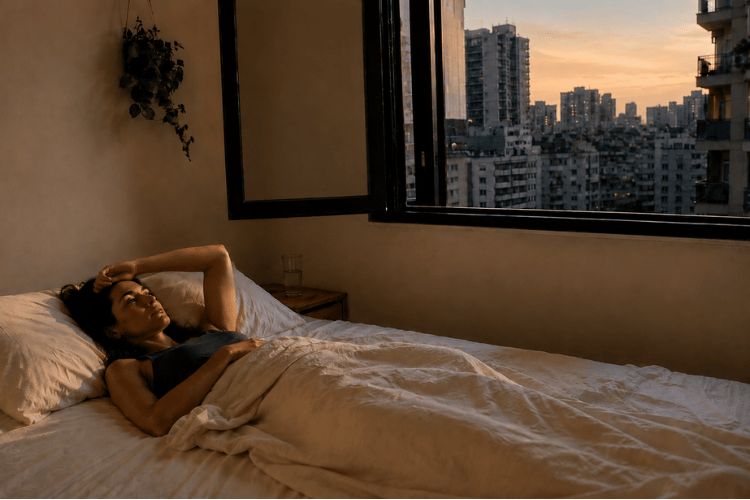
When should you ventilate your home in the summer?
The best time to air out a room is usually in the early morning or late at night, when the outside temperature is as low as possible.
On particularly hot days, however, it is often advisable to keep windows closed during the day and use roller shutters or blinds to reduce direct sunlight.
Whether ventilating is actually advisable, however, does not depend solely on the time of year. The actual conditions indoors and outdoors are the deciding factors.
Measure Indoor Air Quality Instead of Guessing
Many people regularly open their windows in the summer, hoping for cooler air. However, it is often difficult to tell whether this actually makes a difference.
Continuous measurement of key indoor climate parameters provides a significantly better basis for decision-making. Among other things, the following are particularly helpful:
These values help you determine when it is advisable to ventilate and how the indoor climate changes throughout the day.
Especially on hot summer nights, it can be helpful to compare temperature and CO₂ trends. This makes it clear whether the apartment is actually cooling down or whether fresh air is simply circulating in the room while the heat stored in the building materials remains.
Here's how to keep your apartment as cool as possible in the summer
It is often impossible to completely avoid the summer heat. However, taking a few measures can significantly reduce the heat.
Sun protection on windows prevents rooms from heating up unnecessarily during the day. Airing out rooms briefly early in the morning or at night makes the best use of cooler outside air. Electrical appliances should generate as little additional heat as possible, and keeping doors closed to particularly hot rooms is actually effective.
How can the air-Q help with this?
Especially on hot summer nights, our own perceptions are often not enough to accurately assess the indoor climate. If the air feels stuffy, is it due to high CO₂ levels, high humidity, or simply the temperature? And does airing out the room at night actually cool it down?
An air quality monitor such as the air-Q provides objective measurements for this purpose; temperature, humidity, and CO₂ are continuously recorded and clearly displayed. This makes it possible to track how the indoor climate changes throughout the day and night and to determine whether ventilation measures are actually achieving the desired effect.
Historical data is particularly helpful in this regard. It shows when the apartment heats up the most, how quickly it cools down again at night, and at what times ventilating is most effective. Based on this information, ventilation habits can be specifically adjusted to improve the indoor climate over the long term.
Conclusion
If the apartment doesn't cool down at night, it's often not just because of poor ventilation. Especially in cities, stored heat, dense development, and so-called "tropical nights" cause the outside temperature to remain high even at night.
A comfortable indoor climate is therefore achieved not only through regular ventilation, but also by ventilating at the right time and effectively monitoring actual conditions. By keeping an eye on temperature, humidity, and CO₂, you can take more targeted action and ensure better conditions in living and workspaces—even on hot summer nights.


.jpg)


