


Children spend a lot of time in their rooms playing, studying, or sleeping. But the air they breathe there isn’t always harmless. Many pollutants are invisible and can have long-term health consequences. Children are particularly at risk because they breathe more rapidly and their immune systems are still developing.
Which air pollutants are particularly dangerous for children?
In children's rooms, various pollutants can affect air quality. particulates are produced by dust, candles, heaters, or textiles. These fine particles can penetrate deep into the lungs, irritate the airways, and trigger asthma attacks. Volatile organic compounds (VOCs) come from furniture, paints, varnishes, or toys. They can cause headaches, respiratory irritation, allergies, and concentration problems. Mold spores form in high humidity or when ventilation is inadequate. Mold can irritate the airways, exacerbate allergies, and negatively impact overall health. Radon is an invisible radioactive gas that can seep into living spaces from the ground. It increases the long-term risk of lung cancer, particularly in basements or new buildings.
The Effects of Poor Air Quality on Children
Poor air quality doesn't just affect the respiratory system. Children who sleep or study in rooms with poor air quality often exhibit:
- Fatigue and exhaustion
- Irritability and mood swings
- Difficulty concentrating
Allergies and asthma can also worsen. Over the long term, poor air quality can impair lung development, the immune system, and overall performance.
Measures to Improve Air Quality in Children's Rooms
Parents can actively improve the air quality in their children’s rooms. Regular ventilation ensures that fresh air enters the room, especially in the morning and evening. Air purifiers with HEPA filters or activated carbon can significantly reduce particulates, pollen, and VOCs. Humidity should be monitored to prevent mold growth. The ideal humidity level is between 40 and 60 percent. Furniture, paints, and toys should contain as few harmful substances as possible. Radon can only be detected with special measuring devices, so regular testing is advisable.
How the air-Q air analyzer helps
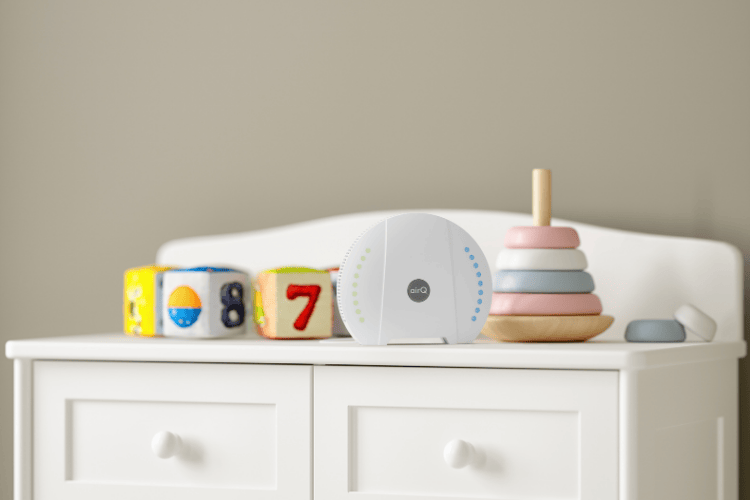
The air-Q air quality analyzer provides precise information about the air quality in a child’s room. It measures particulates, VOCs, CO₂, temperature, humidity, and radon, among other things. This way, parents always know when to ventilate the room, use an air purifier, or take other measures. Continuous monitoring allows risks to be identified early and targeted action to be taken. With air-Q, children’s rooms can become safe and healthy places to play, sleep, and learn.
Take Air Quality in the Children's Room Seriously
Invisible air pollutants in children’s rooms are an underestimated hazard. By regularly ventilating the room, using air purifiers, maintaining proper humidity levels, and utilizing modern monitoring devices like the air-Q, parents can actively ensure that their children wake up to healthy air. This makes the children’s room not only cozy but also safe for your children’s health.


