Assess virus and mold risks using the air-Q air quality indices
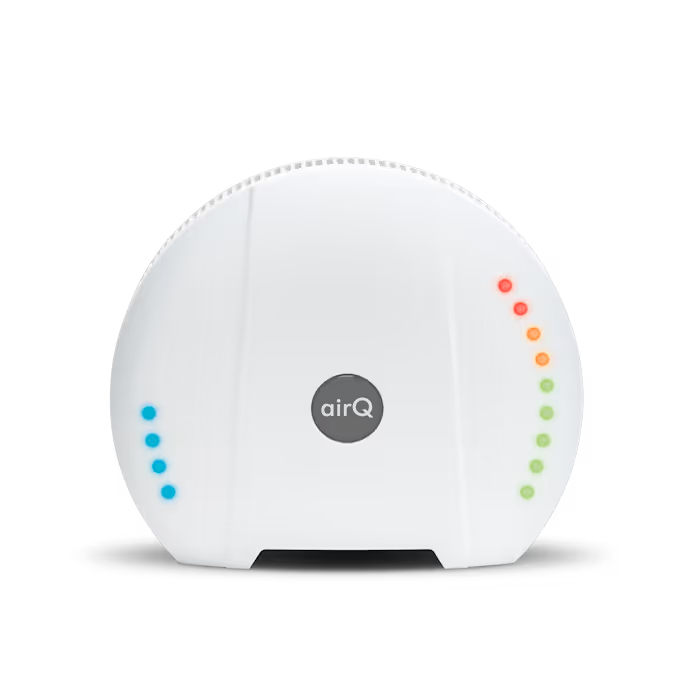
The air-Q air analyzer continuously analyzes all relevant substances in the air we breathe and evaluates them using air quality indices we have developed ourselves. This includes the official threshold values set by the WHO and local environmental authorities, as well as the latest scientific studies. This has enabled us to develop the air-Q Health and Performance Index, the Antiviral Index, and the Anti-Mold Index, which the air-Q displays continuously.

The air-Q air quality indices for health, performance, mold, and viruses

air-Q Health Index Based on Current Official Threshold Values
The air-Q assesses the impact of pollutants on physical health based on the limit values set by the WHO and the German Federal Environment Agency, and calculates the air-Q™ Health Index. The air-Q Health Index is a key component of every air-Q and is calculated individually and in real time based on the respective built-in sensors; thus, the air-Q Pro uses more sensors in the index calculation than the air-Q Light. The air-Q Health Index is preconfigured with a green LED theme on every air-Q. Keep an eye on your health at all times!

The air-Q performance index draws on the findings of current studies
The air-Q™ performance index is based on current research findings and studies that evaluate the impact of air quality on physical and mental performance. The main factors influencing the performance index are carbon dioxide and fine particulate matter, as well as air temperature and humidity. Based on this, the air-Q calculates a continuous index that combines all influencing factors and presents them as a cumulative performance index value. The air-Q performance index comes preconfigured in blue as an LED theme on every air-Q. Always keep an eye on how air quality affects your physical and mental performance!

air-Q Antivirus Index
The air-Q virus index was developed specifically to assess a potential viral load. It uses carbon dioxide as the primary indicator of the potential aerosol load and, therefore, the potential viral load. A high index indicates a low risk of viral transmission; a low index indicates a potentially high risk of viral transmission. The antivirus index can be activated in the air-Q app and is displayed as an individual sensor value. All display options are available for the antivirus index, including LED themes on the air-Q, audible notifications, push notifications/email, and Smart Widgets, among others.

air-Q Mold Resistance Index
The air-Q mold index was developed to assess the potential risk of mold. To do this, it uses changes in humidity and temperature over a specific period as indicators of potential mold growth. A high mold index indicates a low risk of mold growth; a low mold index value indicates a high potential risk of mold. The mold index can be activated in the air-Q app and is displayed as an individual sensor value. All display options are also available for the mold index: LED themes on the air-Q, audible notifications, push notifications/emails, and Smart Widgets, among others. In addition to the continuously calculated air-Q mold index, there is a free mold risk calculator available for testing.
Consideration of Recommendations and Official Threshold Values
air-Q provides advice based on threshold values and official recommendations. To this end, it uses and consolidates the guidelines from the German Federal Environment Agency and the WHO for calculating the air-Q health index.


The air-Q Health Index™ for Air Quality
Air quality directly affects our health. In the short term, dust and dry air can make us more susceptible to colds. Nitrogen oxides—specifically nitrogen dioxide and ozone—can also cause respiratory tract irritation and weaken the respiratory system’s defenses, even with brief exposure.
In the long term, fine particulate matter, nitrogen oxides, sulfur oxides, ozone, formaldehyde, and certain organic compounds (VOCs) pose health concerns and, therefore, should be monitored continuously—ideally 24 hours a day—or avoided if possible.
The air-Q air analyzer takes into account all the hazards posed by these substances and calculates the air-Q™ health index based on official limit values, recommendations from organizations (such as the Federal Environment Agency or the WHO), and scientific studies. The air-Q health index is calculated based on the “worst” measured value among all parameters at a given time. If, for example, a high level of fine particulate matter results in a 20% reduction and a high level of nitrogen dioxide warrants a 30% reduction in health, the health index is calculated as follows: 100% – 30% (nitrogen dioxide value) = 70%. You can check the air-Q app to see exactly which parameter is responsible for your index value.
Finally, the air-Q health advisor enables a highly specific analysis of the causes using artificial intelligence. The air-Q system offers personalized advice for improving air quality, which also benefits the user’s health.
Discover here, on our website, the significant impact of air pollution, air pollutants, and air quality on our health, our lives, and our well-being.
The air-Q Health Index in real time
The air-Q health index comes preset to green as the LED theme and shows in real time how air quality affects your health.
The air-Q Air Quality Performance Index™
Air quality affects not only health, but also well-being and performance. Even after a very short time, the concentration of carbon dioxide in a closed room can reach a level that has a measurable and demonstrable impact on human concentration. After one or two hours in a typical office, carbon dioxide levels are often high enough to increase the error rate and limit the ability to engage in complex thinking.
A very specific relationship has also been demonstrated between concentrations of fine particulate matter, on the one hand, and performance, on the other. Air temperature and humidity also have a lasting impact on cognitive function. And a lack of oxygen also negatively affects health and individual performance. Poor indoor air quality can quickly lead to productivity losses of between 30% and 50%. This is important not only in the office, but also when working remotely or at home in general. Because reduced performance leads to mistakes, which in turn cause additional stress, and possibly dissatisfaction and irritability.
The air-Q air quality analyzer, which measures the quality of the air we breathe and indoor air, records all factors that influence well-being and performance, and calculates the air-Q Performance Index™ for the air we breathe, based on scientific studies and research.
The calculation of the air-Q performance index is based on a cumulative procedure, grounded in current performance studies that have analyzed performance losses due to specific loads in the breathing air. If, for example, a high carbon dioxide content in the air causes a 20% reduction in performance and a high temperature causes a 10% reduction, the performance index is calculated as follows: 100% – 20% (CO₂ reduction) – 10% (temperature reduction) = 70%
The air-Q performance index in real-time operation
The air-Q performance index comes preconfigured with a blue LED theme and shows in real time how air quality affects your performance.