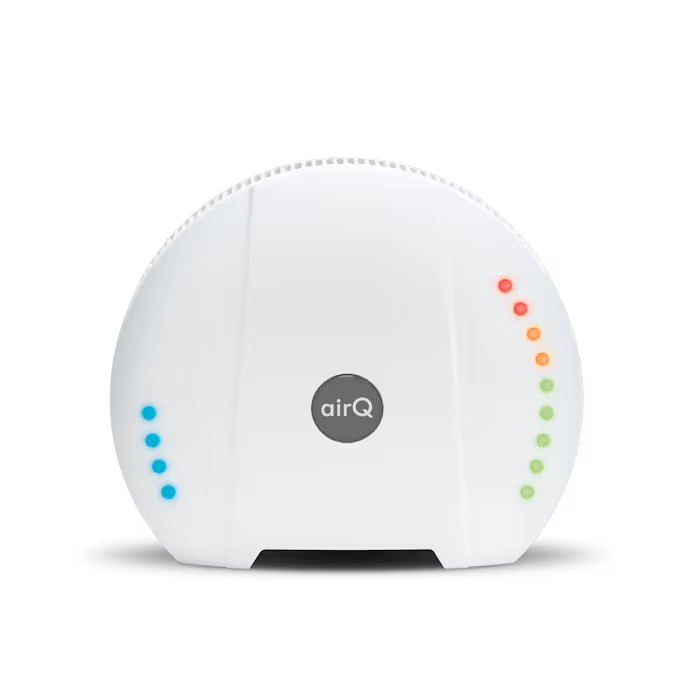
Highly advanced, technically sophisticated, and meeting laboratory standards—air measurement made simple.
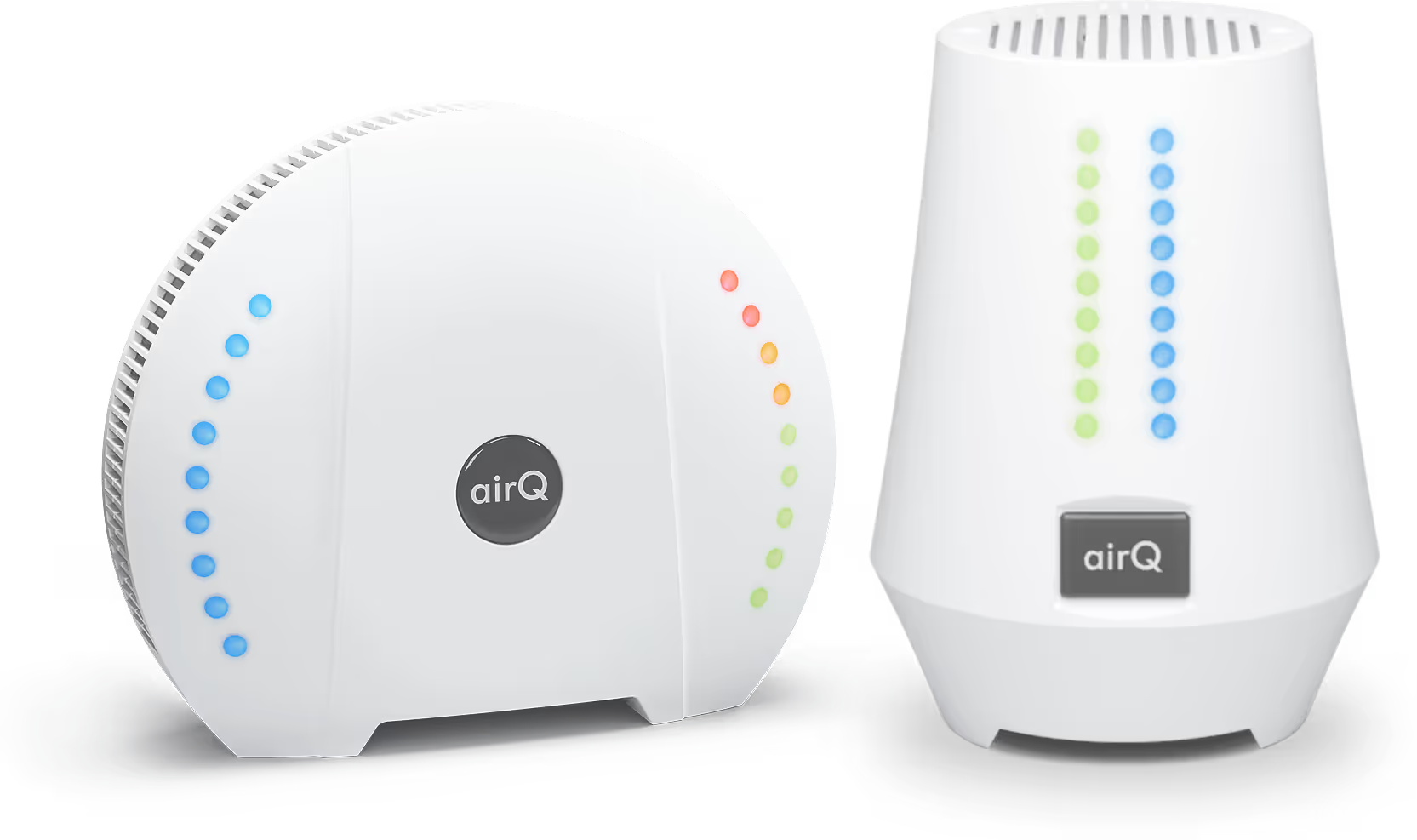
The air-Q and air-Q Radon, featuring the in-house developed radon sensor module, are the result of several years of research and development. In addition to the sensor components, a complex software algorithm was also developed, enabling the detection of previously invisible particles in the air.
Our Scientific Approach to Air Analysis
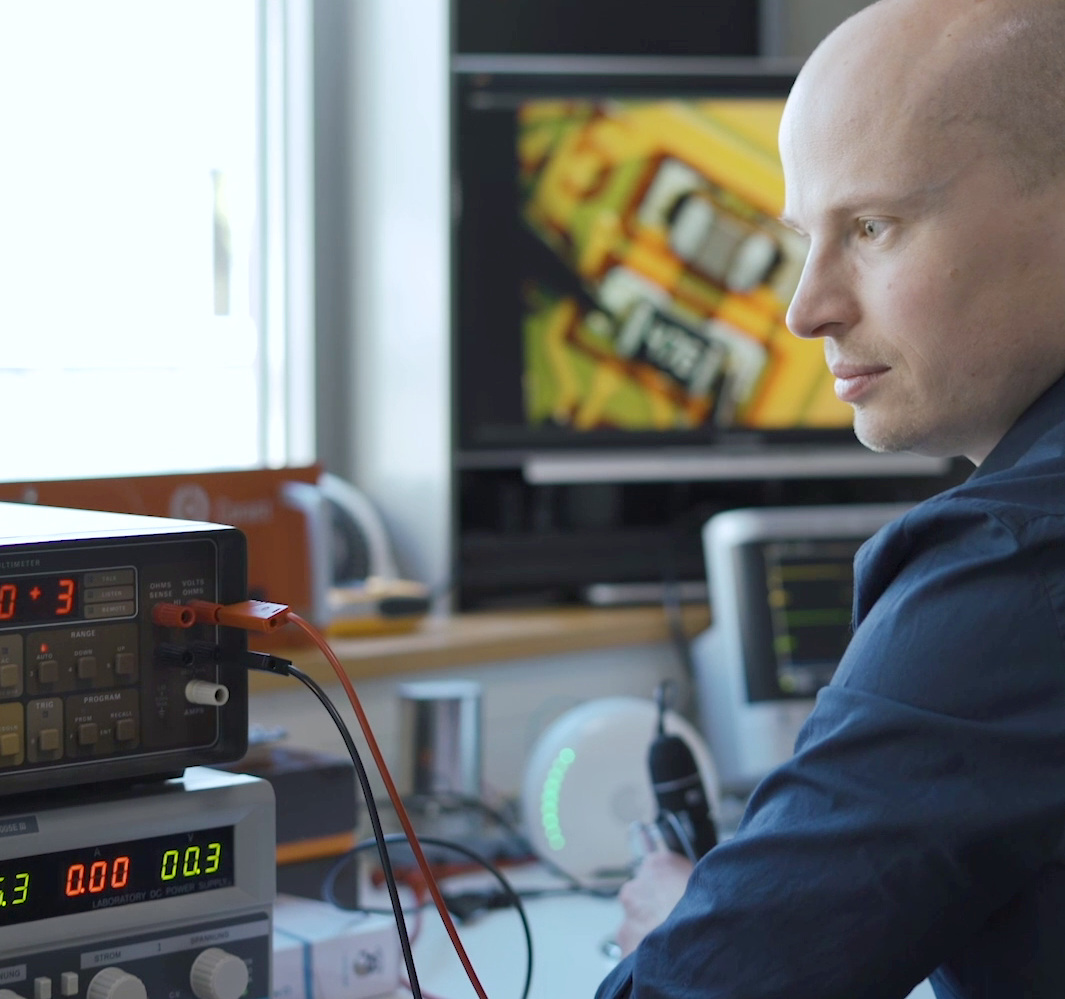
Air-Q technology has been under development since 2015 in accordance with laboratory standards, in collaboration with several scientific partners. The goal of this research was to develop an indoor air detector—the air analyzer—equipped with smart technology that measures air quality according to the most up-to-date standards while remaining compact and affordable.
Thanks to software algorithms, the air-Q can even detect conditions in the air that, until now, could only be identified through laboratory testing. This makes the air-Q the most comprehensive, high-performance, and intelligent air and air quality analyzer—“Made in Germany.”
Technical Specifications
air-Q Series
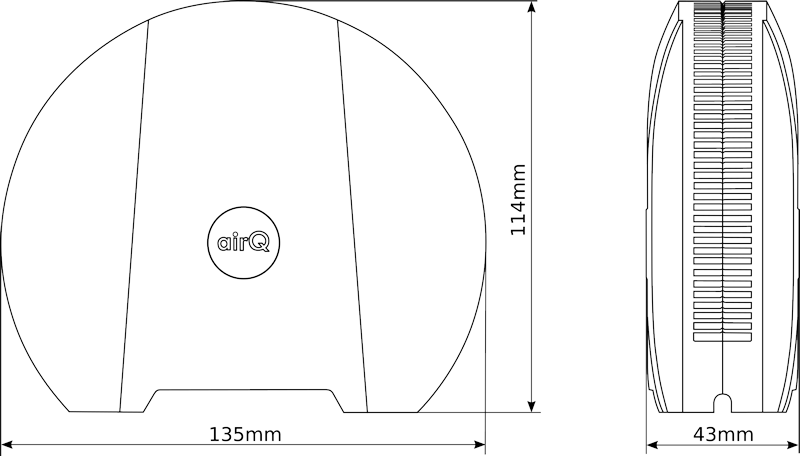
- Dimensions
- 114 × 135 × 43 mm
- Terms of Use
- Temperature 0 to +50 °C Humidity 0–95%
- Interfaces
- WLAN
- Measurement intervals
- 1.8 seconds of continuous operation
- Possible sensors
- Oxygen (O₂), carbon dioxide (CO₂), carbon monoxide (CO), nitrogen dioxide (NO₂), sulfur dioxide (SO₂), ozone (O₃), formaldehyde [specific], VOCs (volatile organic compounds as a group of substances), PM₁, PM₂,₅, and PM₁₀ particle sizes, temperature, relative and absolute humidity, atmospheric pressure, noise level
- Additional Sensors (Selection)
- Hydrogen sulfide (H₂S), ammonia (NH₃), methane (CH₄), hydrogen (H₂), butane (C₄H₁₀), light sensor
- Thesis
- 16 GB Micro-SD card, for about 10 years of data
- Power Supply
- 5 V USB-A to USB-C power adapter, optional battery (e.g., portable USB battery)
air-Q Radon Series
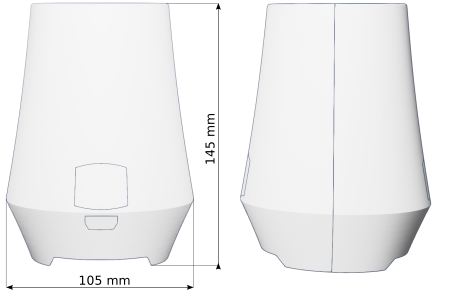
- Dimensions
- 145 × 105 × 105 mm
- Terms of Use
- Temperature: 0 to +50 °C Relative humidity: 15–95%
- Interfaces
- WLAN
- Measurement intervals
- 1.8 seconds of continuous operation
- Possible sensors
- Radon (dedicated measurement module), carbon dioxide (CO₂), VOCs (volatile organic compounds as a group of substances), particle sizes PM₁, PM₂,₅, PM₄, and PM₁₀, particle count, temperature, relative and absolute humidity, atmospheric pressure
- Thesis
- 16 GB Micro-SD card, for about 10 years of data
- Power Supply
- 5 V USB-A to USB-C power adapter, optional battery (e.g., portable USB battery)

Our measured values / sensors:

Hydrogen (H₂)
Hydrogen exists in a stable form only as molecular hydrogen (H₂), a colorless, odorless gas. It reacts rapidly with oxygen (O₂) to form water, releasing energy. H₂ is not toxic, but it is flammable and explosive.

Volatile Organic Compounds (VOCs)
VOCs (volatile organic compounds) are carbon-containing organic compounds that evaporate even at low temperatures. In many cases, VOCs are largely harmless to living organisms—despite their impact on well-being. However, this group of substances also includes substances that are hazardous to health, such as formaldehyde.

Air Temperature (T)
Air temperature has a significant influence on the rate of chemical processes and, therefore, on human metabolism. It is therefore advisable to measure it. Temperatures that are too high or too low can have a negative effect on mental or physical health.

Dew point (Td)
The dew point refers to the temperature at which the relative humidity of the air reaches 100% and at which the water vapor in the air would immediately begin to condense into water.

Nitrogen dioxide (NO₂)
Nitrogen dioxide (NO₂) belongs to the group of nitrogen oxides. It is a reddish-brown gas with a pungent odor similar to that of chlorine. NO₂ severely irritates the respiratory tract and contributes to asthma.

Hydrogen sulfide (H₂S)
Hydrogen sulfide is a colorless, foul-smelling, highly toxic gas that is combustible and highly flammable. It has the characteristic odor of rotten eggs and is produced by the decomposition of proteins derived from sulfur-containing amino acids by putrefactive and sulfur-producing bacteria.

Sulfur dioxide (SO₂)
Sulfur dioxide is a colorless, irritating gas with a pungent odor and a sour taste; humans can detect it at concentrations ranging from 0.8 to 4.0 mg/m³.

Oxygen (O₂)
Molecular oxygen (O₂) is a colorless, odorless gas that makes up 21% of the air. On the Earth's surface, oxygen is—by mass—the most abundant element.

Radon (Rn)
Radon is a noble gas whose decay releases radioactive particles (known as alpha radiation).

Ozone (O₃)
Ground-level ozone (O₃) is formed by the reaction of oxygen, nitrogen oxides, and volatile organic compounds under intense solar radiation. Even at slightly elevated concentrations, it causes severe irritation of the mucous membranes and respiratory tract.

Methane (CH₄)
Methane is a flammable gas and the main component of heating gas.

Relative humidity (ρ)
Air humidity refers to the proportion of water vapor in the gaseous mixture that is air. Air humidity that is too high or too low in indoor spaces can have a negative impact on human well-being and health.

Absolute humidity of the air (φ)
Absolute humidity describes the density of water vapor—that is, the mass of water vapor contained in a given volume of air.

Atmospheric pressure (p)
Atmospheric pressure results from the continuous movement of air masses. As a component of atmospheric environmental conditions, it directly influences human health and well-being.

Lumière / Illuminance (lx)
The light sensor measures light intensity by detecting the brightness of incident light and converting it into a digital signal. It takes into account only the portion of the light spectrum that is perceptible to the human eye and ignores infrared and ultraviolet radiation.

Maximum noise level (Lp_max)
Unlike the “normal” noise level, which reflects background noise, the maximum noise level reflects sudden loud events—such as a loud, brief noise during the night. These events, as recorded by the maximum noise level, can abruptly interrupt rest periods and cause stress.

Bruit (LP)
Sound becomes noise when unwanted sounds are perceived as bothersome, unpleasant, or disruptive. As a psychosocial stressor, noise can significantly impair well-being and performance.

Laughing gas (nitrous oxide) (N₂O)
Nitrous oxide is a colorless, tasteless gas with a slightly sweet odor. Known as “laughing gas,” it is primarily used in medicine as a pain reliever and anesthetic.

Carbon monoxide (CO)
Carbon monoxide (CO) is produced, in particular, during the incomplete combustion of carbon-containing substances. This colorless, odorless, and tasteless gas is a powerful respiratory poison that quickly reaches dangerous concentrations in unventilated rooms.

Carbon dioxide (CO₂)
Carbon dioxide (CO₂) is a natural component of air and is a major greenhouse gas in the Earth’s atmosphere. Excessively high indoor concentrations of carbon dioxide can lead to reduced performance and fatigue, and in severe cases, life-threatening shortness of breath.

Formaldehyde (CH₂O)
Formaldehyde is a colorless substance with a pungent odor that is gaseous at room temperature. Because it is used in adhesives, formaldehyde is now very common indoors and is found in many wood panels and pieces of furniture.

Fine Particulate Matter (PM₁ – PM₂,₅ – PM₁₀)
Fine particles are a mixture of solid and liquid particles in suspension with a very small diameter. Depending on their size and composition, fine particles can cause long-term damage to the respiratory tract and the cardiovascular system. With the air-Q air analyzer, it is possible to measure fine particles of various sizes (PM₁₀, PM₂,₅, PM₁).
Chlorine / chlorine gas (Cl₂)
Chlorine (Cl₂) is a toxic, greenish gas that is highly reactive. At low concentrations, it irritates the mucous membranes and the respiratory tract; at high concentrations, it is corrosive.

Ammonia (NH₃)
Ammonia (NH₃) is a colorless, toxic gas with a pungent odor. It irritates the eyes and respiratory tract and has an asphyxiant effect. As a basic chemical, ammonia is one of the most widely produced industrial chemicals in the world. In nature, it occurs as a reaction product of urea and various salts.
Learn everything there is to know about all the gases and particles in the air you breathe.

L’air-Q has an extensive database on all relevant gases and particles present in the air we breathe—such as carbon dioxide, nitrogen dioxide, sulfur dioxide, fine particulate matter, and many others. It includes the sources and causes of certain air pollutants, their effects on the body, and all current limit values. This data is also used to calculate the health index and the performance index.
≥ Everything you need to know about the gases and particles in the air we breathe!
Health Index and Performance Index™
The air-Q Health Index and the air-Q Performance Index provide a quick overview of the air quality in your home or office. The indices are calculated continuously based on current official air quality limits and displayed on the air-Q device as well as in the app.

Air-Q Health Index

Air-Q Performance Index
Consideration of recommendations and official limit values
air-Q provides advice based on official limit values and recommendations. To this end, guidelines from the Federal Office for the Environment and the WHO are used and consolidated to calculate the air-Q health index.



Online/Offline
The L’air-Q can connect to your local Wi-Fi network or set up its own Wi-Fi hotspot. This gives you direct access to your air quality data from anywhere.

Digitally Connected in the Smart Home
IFTTT, Alexa, Homebridge for Apple HomeKit, openHAB, Homey, and other smart home standards are supported. Google Assistant, among others, will be added soon.

Data Storage
L’air-Q stores more than ten years’ worth of all collected data on its internal memory (SD card). The data can be exported (in CSV format).

Data Security
All your data stays with you. Nothing is sent to the cloud or to third-party servers unless you specifically choose to do so. This way, you retain control over your data.

Cloud Services
If needed, you can also view all air quality data via our cloud. This allows you to check the air quality in your living or working spaces from anywhere—on a computer or smartphone.

Interface API
L’air-Q offers APIs that allow you to view and transfer all data, including to third-party software.

Precision
During continuous operation, the air-Q’s high-precision sensors collect all data on the air being breathed and the environment every second.

Longevity
The air-Q sensors were selected for optimal durability. They are based on optical or electrochemical measurement principles and provide measurements for 5 to 10 years.

Sustainability
Our electrochemical sensors have a long minimum service life of 5 to 10 years. After this period, you can easily have individual components replaced by us and continue using the device.

Scalability
L’air-Q features a base with an additional empty slot for another sensor of your choice. This allows for the fulfillment of highly customized measurement requirements.
Certified Quality

The WELL standard is an international building certification rating system developed and regulated by the Well Building Institute (IWBI) in the United States. It is the first standard of its kind to focus exclusively on the health and well-being of people in buildings, with high standards. Air-Q meets the high standards that WELL sets for air quality measurement and is certified by theIWBI.
Our Partners in Sensor Development
We are developing the air-Q air analyzer and the air-Q app in collaboration with numerous partners to improve people’s health and performance. Our development partners, with whom we work every day on new solutions for healthy and mindful breathing and living, are particularly important in this regard.