Information on exposure limits for gases, particulates, and pollutants in the air we breathe.
Limit values are the subject of heated debate. Many people believe they are too low, while others think they are too high. The important thing, however, is to be aware of them and to understand the context for yourself—for example, why much higher limit values are often permitted in the workplace than at home or outdoors. We have compiled this information for you here on exposure limits for gases, particulate matter, and pollutants in the air we breathe.

What are the legal limits for air pollutants? Find out here. For your health and well-being!
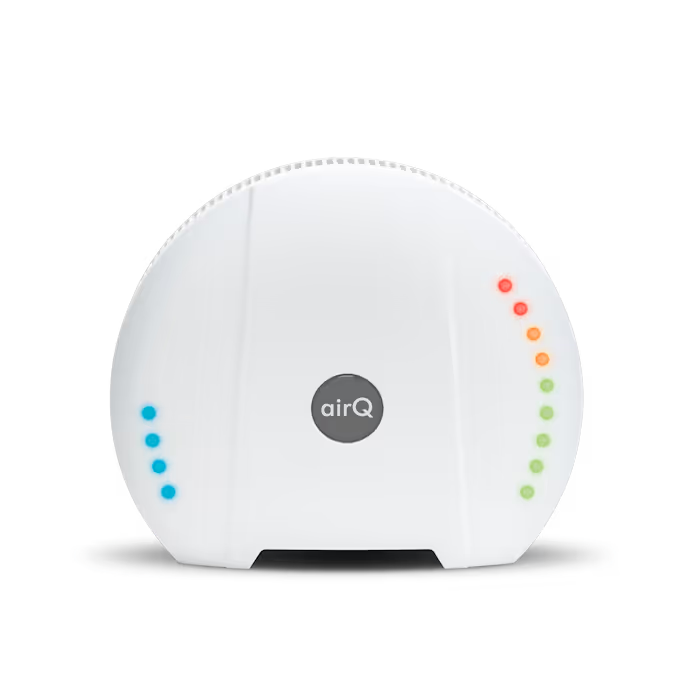
Here you will find an overview of the often complex definitions of limit values for air pollutants such as fine particulate matter, nitrogen dioxide, VOCs, formaldehyde, and ozone, as established by the Federal Office for the Environment or the WHO. Limit values for certain pollutants are distinguished based on whether they are measured outdoors, indoors, or in the workplace. In fact, it is often difficult to maintain a clear overview and determine when action is needed. The air-Q air analyzer helps you by monitoring these limit values for you.
-
Designation PM 1 PM 2.5 PM 10 Daily Guideline Value from the Federal Environment Agency - 15 µg/m³ - Daily Limit Value Set by the Federal Environment Agency - - 50 µg/m³ Annual Limit Value Set by the Federal Environment Agency - 25 µg/m³ 40 µg/m³
The Federal Office for the Environment sets a daily limit value of 50 μg/m³ for PM10 particulate matter, which may be exceeded on no more than 35 days per year. In general, a maximum annual average of 40 μg/m³ applies. For smaller PM2.5 particles, there are only non-binding target values of 25 μg/m³ set by the EU and the WHO. For even smaller particles—which are significantly more dangerous—there are currently no limit values in place.Learn more✓ Can be measured usingthe air-Q basic,air-Q pro,air-Q science, andair-Q radon science.
-
Designation EU Outdoor Air Quality Limits Workstation Limit Values Approximate interior dimensions Long-Term Investments 40 µg/m³ - 40 µg/m³ Short-term securities Average 1-hour emission limit value: 200 µg/m³,
; average 3-hour alert threshold: 400 µg/m³- Average 1-hour precautionary level: 80 µg/m³,
; average 1-hour hazard level: 250 µg/m³Working Group - 950 µg/m³ -
The EU sets a limit value of 200 µg/m³ as the ceiling for the one-hour average. This limit may not be exceeded more than 18 times per year. If a value of 400 µg/m³ is exceeded for three hours, immediate action must be taken. The Federal Office for the Environment sets guideline values for indoor spaces—80 µg/m³ as a one-hour average and 40 µg/m³ as an annual average. The short-term alert threshold is set at 250 µg/m³.The occupational exposure limit (MAK) for NO₂ is set at 950 µg/m³, with numerous exceptions. However, this high limit applies specifically to workers exposed to elevated levels of nitrogen dioxide in the workplace—and therefore not to those working in offices. The Federal Office for the Environment recommends—including indoors—setting the maximum weekly average at 40 µg/m³.
Learn more✓ Can be measured using air-Q pro as well as air-Q science
-
Designation Carbon Dioxide Limit Values Recommendation from the Federal Office for the Environment 1,000 ppm DIN 1946-2 limit value for good air quality 1,500 ppm MAK Values for Workstations 5,000 ppm
The Federal Environment Agency already recommends ventilating the space as soon as the carbon dioxide level exceeds 1,000 ppm. The maximum concentration in the workplace (MAK value) sets a limit of 5,000 ppm. The DIN 1946-2 standard, which has since been repealed, set a limit of 1,500 ppm. In children’s rooms, bedrooms, and crowded classrooms or meeting rooms, levels exceeding 5,000 ppm can be measured very quickly.Learn more✓ Can be measured usingthe air-Q light,air-Q basic,air-Q pro,air-Q science, andair-Q radon science.
-
Designation Carbon Monoxide Limit Values 24-hour forecast from the Federal Office for the Environment 4 mg/m³ (3.2 ppm) 8-hour guideline value from the Federal Office for the Environment 10 mg/m³ (8 ppm) WHO Recommendation: 1-hour value 25 mg/m³ (20 ppm) MAK Value 35 mg/m³ (28 ppm) 15-minute estimate from the Federal Office for the Environment 100 mg/m³ (80 ppm) WHO recommendation: 15-minute value 85 mg/m³ (68 ppm)
The Federal Office for the Environment sets a 24-hour average limit of 4 mg/m³ for carbon monoxide. The maximum workplace concentration (MAK value) for carbon monoxide is set at 35 mg/m³—MAK values do not apply to pregnant women or individuals with preexisting medical conditions. The WHO recommends that concentrations above 25 mg/m³ should not be inhaled for more than one hour, and concentrations up to 85 mg/m³ for no more than 15 minutes. The Federal Office for the Environment is slightly less strict in this regard, setting the limit at 100 mg/m³.
Learn more✓ Can be measured using theair-Q basic,air-Q pro, andair-Q science
-
Designation Oxygen Limit Values DGUV Rule 113-004 for Work in Silos and Confined Spaces 17 %
There are no legal limit values foroxygen in Germany. DGUV Regulation 113-004 of the German statutory workers' compensation insurance system for occupational safety sets a limit of 17% oxygen. The amount of oxygen still present in exhaled air is 16%.
Learn more✓ Measurable using Air-Q Science and the individual oxygen sensor
-
Designation Ozone Limit Values Maximum 8-hour value from the Federal Office for the Environment 120 µg/m³ Federal Environment Agency Information Threshold (1-hour average) 180 µg/m³ Federal Environment Agency Alert Level (1-hour average) 240 µg/m³
The Federal Environment Agency has set a maximum 8-hour ozone level of 120 µg/m³ (60 ppb), which may be exceeded on no more than 25 days per calendar year. The UBA, however, recommends that this level not be exceeded at all. When levels reach 180 µg/m³, the public must be informed; when levels reach 240 µg/m³, an ozone alert must be issued.There is currently no occupational exposure limit (AGW, formerly MAK). Since no AGW has yet been established for ozone, the former MAK value of 200 µg/m³ serves as a non-binding guideline. For offices, the limit values set by the Federal Environment Agency apply.
Learn more✓ Can be measured using theair-Q pro and theair-Q science
-
Designation Sulfur Dioxide Limit Values 1-Hour Limit Value 350 µg/m³ Daily Limit Value 125 µg/m³ Annual/Winter Limit Value 20 µg/m³
The EU has set the following limit values for sulfur dioxide: the hourly limit value is 350 µg/m³, and the daily limit value is 125 µg/m³. In addition, an alert threshold of 500 µg/m³ applies to sulfur dioxide. As an occupational exposure limit (MAK value), a concentration of 2.5 mg/m³ (1,000 µg/m³ or 1 ppm) has been set for sulfur dioxide.
Learn more✓ Can be measured using the additional sulfur dioxide sensor.
-
Designation Radon Limit Values EU-wide Euratom standards 300 Bq/m³ on average per year Guideline value for planning new buildings 200 Bq/m³ as an annual average WHO Recommendation 100 Bq/m³
The German Radiation Protection Act sets the reference value for radon concentrations. Indoors, the limit of 300 becquerels per cubic meter (Bq/m³) applies—which means 300 decays per second per cubic meter of air. Upon request, the landlord or employer must be able to provide evidence of these values. The German Commission on Radiation Protection (SSK) recommends ventilating the space once levels reach 250 Bq/m³ and reducing the level permanently to below 100 Bq/m³—as does the World Health Organization (WHO). Above 1,000 Bq/m³, radon remediation measures should be undertaken to protect against radon.Learn more✓ Can be measured usingair-Q radon andair-Q radon science.
-
Designation Absolute Air Humidity Limits General Recommendation: Minimum Value 6.9 g/m³ General Recommendation: Maximum Value 10.4 g/m³
There are no established limit values for absolute air humidity. Values ranging from 6.9 to 10.4 g/m³ are recommended, as these represent the boundaries between air that is too dry and air that is too humid at room temperature. At lower or higher temperatures, however, these values can quickly become uncomfortable.
Learn more✓ Can be measured usingthe air-Q light,air-Q basic,air-Q pro,air-Q science,air-Q radon, andair-Q radon science.
-
Designation Relative Humidity Limits General Recommendation: Minimum Value 40 % General Recommendation: Maximum Value 60 %
There are no legal limits for relative humidity. In enclosed spaces, a relative humidity of between 40 and 60% is recommended. A range of 30 to 70% relative humidity is considered acceptable. If relative humidity exceeds 95% or falls below 23%, most people find the air uncomfortable.
Learn more✓ Can be measured usingthe air-Q light,air-Q basic,air-Q pro,air-Q science,air-Q radon, andair-Q radon science.
-
Designation Methane Limit Values Lower Explosive Limit (LEL) 29 g/m³ (or 4.4% by volume)
Since methane is non-toxic to humans, no exposure limit has been set for this gas. However, methane's high flammability poses a significant risk. The lower explosive limit (LEL) is set at a methane concentration of 29 g/m³—which corresponds to 4.4% by volume. Above this limit, the flame propagates autonomously throughout the gas mixture upon ignition (explosion).Methane is also known as a dangerous greenhouse gas and, as such, a contributor to human-induced climate change. In recent years, the concentration of methane in the atmosphere has been rising rapidly.
Learn more✓ Measurable (via the VOC gas group) usingthe air-Q light,air-Q basic, andair-Q pro, as well asthe air-Q science, or via the individual methane sensor.
-
Designation Formaldehyde Limit Values Federal Institute for Risk Assessment (BfR) 0.1 ppm (or 124 µg/m³) WHO Recommendation 0.08 ppm (or approximately 100 µg/m³) MAK Value (Maximum Allowable Concentration in the Workplace) 0.3 ppm (or 370 µg/m³)
The Federal Institute for Risk Assessment (BfR) sets a maximum formaldehyde concentration of 0.1 ppm (parts per million). The World Health Organization (WHO) recommends a maximum of 0.08 ppm as the formaldehyde limit. In the workplace, the MAK value of 0.3 ppm applies.Learn more✓ Can be measured usingthe air-Q Formaldehyde Special,air-Q Pro,air-Q Science, or the standalone formaldehyde sensor. Formaldehyde is also detected via the VOC sensor as a cumulative VOC value, which is included in every air-Q model (air-Q light, air-Q basic, and air-Q pro).
-
Designation Atmospheric Pressure Limits No limit value defined -
There are no relevant limit values for atmospheric pressure in normal environments. In the workplace, significant deviations from the normal pressure of 1 hPa may also occur. Below 0.73 and above 3.6 hPa, special permits are required. Even deviations of 0.1 hPa from normal atmospheric pressure can cause significant health hazards, and certain groups of workers can no longer be employed.
Learn more✓ Can be measured usingthe air-Q basic,air-Q pro,air-Q science,air-Q radon, andair-Q radon science.
-
Designation Noise Limit Values Federal Act on Protection Against Nuisances (Noise Ordinance) — Interior Day: 35 dB
Night: 25 dBFederal Act on Protection Against Nuisances (Noise Ordinance) — Thermal and Recreation Areas Day: 45 dB
Night: 35 dBFederal Act on Protection Against Nuisances (Noise Ordinance) — Purely Residential Zones Day: 50 dB
Night: 35 dBFederal Act on Protection Against Nuisances (Noise Ordinance) — Mixed-Use Zones Daytime: 60 dB
Nighttime: 45 dBWHO Recommendations for Wind Turbines Near Residential Areas Jour 45 dB
The official TA Lärm (Technical Instruction on Noise Protection) sets maximum noise levels for indoor spaces (25 dB at night, 35 dB during the day). Outdoors, different limits apply depending on the zone—in purely residential areas, for example, 50 dB during the day and 35 dB at night. The WHO has issued a series of recommendations for certain noise sources and certain areas. In the immediate vicinity of wind turbines, for example, the WHO recommends a maximum noise level of 45 dB; road traffic noise should remain below 53 dB during the day and 45 dB at night—always measured outdoors. For protection against noise pollution in the workplace, the Regulation on Protection Against Noise and Vibrations at Work (LärmVibrationsArbSchV) applies. This regulation sets different limit values depending on the type of activity, duration, and specific location of noise exposure. For offices, for example, there are no specific limit values.
Learn more✓ Can be measured usingthe air-Q light,air-Q basic, andair-Q pro, as well as theair-Q science
-
Designation Noise Limit Values Federal Act on Protection Against Nuisances (Noise Ordinance) — Interior Day: 35 dB
Night: 25 dBFederal Act on Protection Against Nuisances (Noise Ordinance) — Thermal and Recreation Areas Day: 45 dB
Night: 35 dBFederal Act on Protection Against Nuisances (Noise Ordinance) — Purely Residential Zones Day: 50 dB
Night: 35 dBFederal Act on Protection Against Nuisances (Noise Ordinance) — Mixed-Use Zones Daytime: 60 dB
Nighttime: 45 dBWHO Recommendations for Wind Turbines Near Residential Areas Jour 45 dB
The official TA Lärm (Technical Instruction on Noise Protection) sets maximum noise levels for indoor spaces (25 dB at night, 35 dB during the day). Outdoors, different limits apply depending on the zone—in purely residential areas, for example, 50 dB during the day and 35 dB at night. The WHO has issued a series of recommendations for certain noise sources and certain areas. In the immediate vicinity of wind turbines, for example, the WHO recommends a maximum noise level of 45 dB; road traffic noise should remain below 53 dB during the day and 45 dB at night—always measured outdoors. For protection against noise pollution in the workplace, the Regulation on Protection Against Noise and Vibrations at Work (LärmVibrationsArbSchV) applies. This regulation sets different limit values depending on the type of activity, duration, and specific location of noise exposure. For offices, for example, there are no specific limit values.Learn more✓ Can be measured usingthe air-Q light,air-Q basic, andair-Q pro, as well as theair-Q science
-
Designation Ambient Temperature Limits Recommendation from the Federal Office for the Environment - Habitat 21 °C to 23 °C Recommendation from the Federal Office for the Environment - Offices 21 °C to 22 °C Recommendation from the Federal Office for the Environment - Children's Room 21 °C to 23 °C Recommendation from the Federal Office for the Environment - Bedroom 16 °C to 18 °C Maximum value according to the Workplace Directive (ASR) - Offices 26 °C
The Federal Office for the Environment issues recommendations for room temperature based on the room's use (e.g., living rooms 21 to 23 °C, children's rooms and bathrooms 23 °C, bedrooms 16 to 18 °C). For offices, a room temperature between 21 and 22 °C is recommended. According to the Workplace Ordinance (ASR), the maximum temperature in work areas must not exceed 26 °C; otherwise, the employer is required to take measures.Learn more✓ Can be measured using air-Q light, air-Q basic, air-Q pro, air-Q science, air-Q radon, and air-Q radon science.
-
Field of Activity / Use of the Part Minimum illuminance value E (lx) Precision work, e.g., sanding decorative elements, color checks, assembly work 1000 lx Writing, reading, data processing 500 lx Archives 200 lx Break rooms, waiting rooms, locker rooms 200 lx
In Germany, there are recommendations for workstations regarding the type and direction of lighting, as well as measures to protect the eyes from the resulting eye strain.
In its document “Technical Rules for Workplaces,” the Federal Institute for Occupational Safety and Health (BAuA) sets forth the following minimum values in May 2023 regarding “lighting and visual contact”:
Learn more✓ Can be used as an additional sensor withair-Q Science
-
Designation VOC Limit Values Federal Office for the Environment - Hygienically Safe <1 mg/m³ – de 150 à 400 ppb (parties par milliard) Federal Office for the Environment - Notable for its hygiene standards 1 to 3 mg/m³ – 400 to 1,200 ppb Federal Office for the Environment - a public health concern 3 to 10 mg/m³ – 1,200 to 4,000 ppb Federal Office for the Environment - Unacceptable from a Health Perspective >10 mg/m³ – more than 4,000 ppb
The Federal Office for the Environment issues recommendations regarding the presence of volatile organic compounds (VOCs), ranging from hygienically harmless (less than 1 mg/m³ – less than 150 ppb) to hygienically significant (between 1 and 3 mg/m³ – 150 to 1,300 ppb) and health-wise concerning (between 3 and 10 mg/m³ – 1,300 to 4,000 ppb) up to health-wise unacceptable (more than 10 mg/m³ – more than 1,500 to 4,000 ppb). Many legally relevant sources specify mg/m³ as the unit. However, what is actually measured is a mixture of numerous substances with different molecular weights (also known as TVOC), whose volume fraction in the air is expressed in ppb (parts per billion) or ppm (parts per million). To date, there are no legal regulations in Germany setting limit values for VOCs except for workstations that are particularly exposed during production processes.Learn more✓ Can be measured using air-Q light, air-Q basic, air-Q pro, air-Q science, air-Q radon, and air-Q radon science.
-
Designation Dew Point Limits General Recommendation: Minimum Value 9 °C General Recommendation: Maximum Value 15 °C Learn more✓ Can be measured using air-Q light, air-Q basic, air-Q pro, air-Q science, air-Q radon, and air-Q radon science.
-
Designation Nitrous Oxide (N₂O) Limit Values Occupational Exposure Limit (AGW) (DFG MAK) 100 ppm (180 mg/m³) Learn more✓ Can be measured usingthe Air-Q Science or the individual nitrous oxide (laughing gas) (N₂O) sensor.
-
Designation Hydrogen Sulfide Limit Values Occupational Exposure Limit (AGW) 5 ppm (equivalent to approximately 7 mg/m³) MAK Value (Maximum Allowable Concentration in the Workplace) 10 ppm (equivalent to approximately 14 mg/m³) Learn more✓ Can be measured using air-Q pro as well as air-Q science
-
Designation Ammonia Limit Values Recommendation from the Federal Office for the Environment Regarding Outdoor Air <700 µg/m³ (1 ppm) Limit value according to the Regulation on Animal Welfare in Livestock Farming (TierSchNutztV) 14,000 µg/m³ (20 ppm) Occupational Exposure Limit (AGW) 14,000 µg/m³ (20 ppm) Learn more✓ Can be measured usingthe air-Q Science or the individual ammonia sensor.
-
Since this gas has no direct effects on human health, no limit value has been established.
Designation Hydrogen Limit Values Lower flammability limit 4% Upper flammability limit 76% Lower Explosivity Limit 18% Learn more✓ Can be measured using theair-Q Science or the individual hydrogen sensor.
-
Designation Chlorine (Cl₂) Limit Values Olfactory threshold 0.02 ppm - 1 ppm Occupational Exposure Limit (AGW) 0.5 ppm (= 1.5 mg/m³ of air) Learn more✓ Can be measured usingthe air-Q Science or the individual chlorine (Cl₂) sensor.
- Learn more
✓ Measurable with the air-Q Science upon request.
- Learn more
✓ Measurable with the air-Q Science upon request.
- Learn more
✓ Can be measured usingAir-Q Science upon request.
- Learn more
✓ Can be measured usingAir-Q Science upon request.
- Learn more
✓ Can be measured usingAir-Q Science upon request.
- Learn more
✓ Can be measured usingAir-Q Science upon request.
- Learn more
✓ Can be measured usingAir-Q Science upon request.
- Learn more
✓ Can be measured usingAir-Q Science upon request.
- Learn more
✓ Can be measured usingAir-Q Science upon request.
- Learn more
✓ Can be measured usingAir-Q Science upon request.
- Learn more
✓ Can be measured usingAir-Q Science upon request.
- Learn more
✓ Can be measured usingAir-Q Science upon request.
- Learn more
✓ Can be measured usingAir-Q Science upon request.
- Learn more
✓ Can be measured usingAir-Q Science upon request.
- Learn more
✓ Can be measured usingAir-Q Science upon request.
- Learn more
✓ Can be measured usingthe air-Q Science or the individual HF sensor.
- Learn more
✓ Can be measured usingAir-Q Science upon request.
- Learn more
✓ Can be measured usingAir-Q Science upon request.
- Learn more
✓ Can be measured usingAir-Q Science upon request.
- Learn more
✓ Can be measured usingAir-Q Science upon request.
- Learn more
✓ Can be measured usingAir-Q Science upon request.
- Learn more
✓ Can be measured usingAir-Q Science upon request.
- Learn more
✓ Can be measured usingAir-Q Science upon request.
- Learn more
✓ Can be measured usingAir-Q Science upon request.
-
For infrasound, there is no fixed, generally applicable limit value, as there is for many air pollutants. In Germany, low-frequency noise and noise emissions are primarily assessed according to the TA Lärm and the DIN 45680 standard. The focus is not on isolated, fixed values, but rather on the frequency spectrum, sound pressure level, measurement location, and duration of exposure. Particularly low frequencies, below 20 Hz, are referred to as infrasound and must be detected using appropriate measurement techniques, as conventional dB(A) values often do not adequately reflect this exposure.
Learn more✓ Can be measured usingAir-Q Science upon request.