
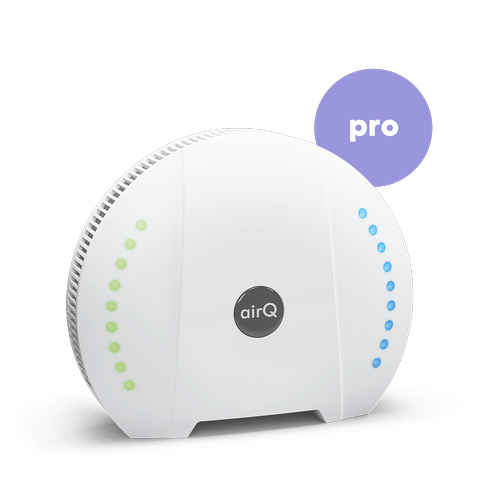
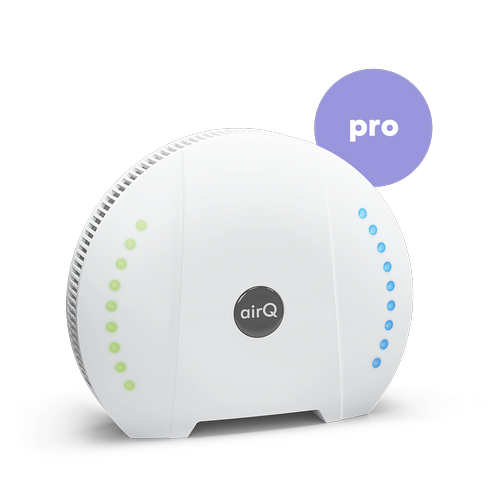
air-Q pro - The professional choice for ambitious users
- Carbon Dioxide
- Volatile Organic Compounds
- Relative humidity
- Air Temperature
- Bruit
- Fine Particles
- Carbon monoxide
- Nitrogen Dioxides
- Atmospheric pressure
- Formaldehyde
- Ozone
Avec plus de 13 capteurs, vous surveillez l’air pour détecter les substances toxiques et les dangers. Les situations dangereuses telles que la fumée et le feu peuvent être signalées bien plus tôt.
Acheter l’air-Q et enregistrer 14 grandeurs mesurées ou plus

Nous passons une grande partie de notre temps en intérieur. On y trouve de nombreuses sources possibles de polluants et de substances accompagnatrices pouvant se trouver dans l’air. Avec l’air-Q, vous pouvez vraiment mesurer tous les gaz et aérosols susceptibles d’apparaître. Cela permet de trouver les causes et de révéler les sources. Les analyses mettent souvent au jour des éléments passionnants et parfois surprenants.
Personne n’offre plus de capteurs que l’air-Q ! Avec 14 capteurs dédiés plus un capteur supplémentaire (air-Q Science), l’air-Q mesure tout ce qui peut se trouver dans l’air. D’autres « capteurs virtuels » complètent l’appareil de mesure avec actuellement deux grandeurs mesurées calculées (par ex. le point de rosée). Grâce à des mises à jour logicielles régulières, d’autres capteurs virtuels viendront s’ajouter, exploitant les propriétés des capteurs matériels intégrés pour obtenir des informations supplémentaires.

Hydrogen exists in a stable form only as molecular hydrogen (H₂), a colorless, odorless gas. It reacts rapidly with oxygen (O₂) to form water, releasing energy. H₂ is not toxic, but it is flammable and explosive.

VOCs (volatile organic compounds) are carbon-containing organic compounds that evaporate even at low temperatures. In many cases, VOCs are largely harmless to living organisms—despite their impact on well-being. However, this group of substances also includes substances that are hazardous to health, such as formaldehyde.

Air temperature has a significant influence on the rate of chemical processes and, therefore, on human metabolism. It is therefore advisable to measure it. Temperatures that are too high or too low can have a negative effect on mental or physical health.

The dew point refers to the temperature at which the relative humidity of the air reaches 100% and at which the water vapor in the air would immediately begin to condense into water.

Nitrogen dioxide (NO₂) belongs to the group of nitrogen oxides. It is a reddish-brown gas with a pungent odor similar to that of chlorine. NO₂ severely irritates the respiratory tract and contributes to asthma.

Hydrogen sulfide is a colorless, foul-smelling, highly toxic gas that is combustible and highly flammable. It has the characteristic odor of rotten eggs and is produced by the decomposition of proteins derived from sulfur-containing amino acids by putrefactive and sulfur-producing bacteria.

Sulfur dioxide is a colorless, irritating gas with a pungent odor and a sour taste; humans can detect it at concentrations ranging from 0.8 to 4.0 mg/m³.

Molecular oxygen (O₂) is a colorless, odorless gas that makes up 21% of the air. On the Earth's surface, oxygen is—by mass—the most abundant element.

Radon is a noble gas whose decay releases radioactive particles (known as alpha radiation).

Ground-level ozone (O₃) is formed by the reaction of oxygen, nitrogen oxides, and volatile organic compounds under intense solar radiation. Even at slightly elevated concentrations, it causes severe irritation of the mucous membranes and respiratory tract.

Methane is a flammable gas and the main component of heating gas.

Air humidity refers to the proportion of water vapor in the gaseous mixture that is air. Air humidity that is too high or too low in indoor spaces can have a negative impact on human well-being and health.

Absolute humidity describes the density of water vapor—that is, the mass of water vapor contained in a given volume of air.

Atmospheric pressure results from the continuous movement of air masses. As a component of atmospheric environmental conditions, it directly influences human health and well-being.

The light sensor measures light intensity by detecting the brightness of incident light and converting it into a digital signal. It takes into account only the portion of the light spectrum that is perceptible to the human eye and ignores infrared and ultraviolet radiation.

Unlike the “normal” noise level, which reflects background noise, the maximum noise level reflects sudden loud events—such as a loud, brief noise during the night. These events, as recorded by the maximum noise level, can abruptly interrupt rest periods and cause stress.

Sound becomes noise when unwanted sounds are perceived as bothersome, unpleasant, or disruptive. As a psychosocial stressor, noise can significantly impair well-being and performance.

Nitrous oxide is a colorless, tasteless gas with a slightly sweet odor. Known as “laughing gas,” it is primarily used in medicine as a pain reliever and anesthetic.

Carbon monoxide (CO) is produced, in particular, during the incomplete combustion of carbon-containing substances. This colorless, odorless, and tasteless gas is a powerful respiratory poison that quickly reaches dangerous concentrations in unventilated rooms.

Carbon dioxide (CO₂) is a natural component of air and is a major greenhouse gas in the Earth’s atmosphere. Excessively high indoor concentrations of carbon dioxide can lead to reduced performance and fatigue, and in severe cases, life-threatening shortness of breath.

Formaldehyde is a colorless substance with a pungent odor that is gaseous at room temperature. Because it is used in adhesives, formaldehyde is now very common indoors and is found in many wood panels and pieces of furniture.

Fine particles are a mixture of solid and liquid particles in suspension with a very small diameter. Depending on their size and composition, fine particles can cause long-term damage to the respiratory tract and the cardiovascular system. With the air-Q air analyzer, it is possible to measure fine particles of various sizes (PM₁₀, PM₂,₅, PM₁).
Chlorine (Cl₂) is a toxic, greenish gas that is highly reactive. At low concentrations, it irritates the mucous membranes and the respiratory tract; at high concentrations, it is corrosive.

Ammonia (NH₃) is a colorless, toxic gas with a pungent odor. It irritates the eyes and respiratory tract and has an asphyxiant effect. As a basic chemical, ammonia is one of the most widely produced industrial chemicals in the world. In nature, it occurs as a reaction product of urea and various salts.
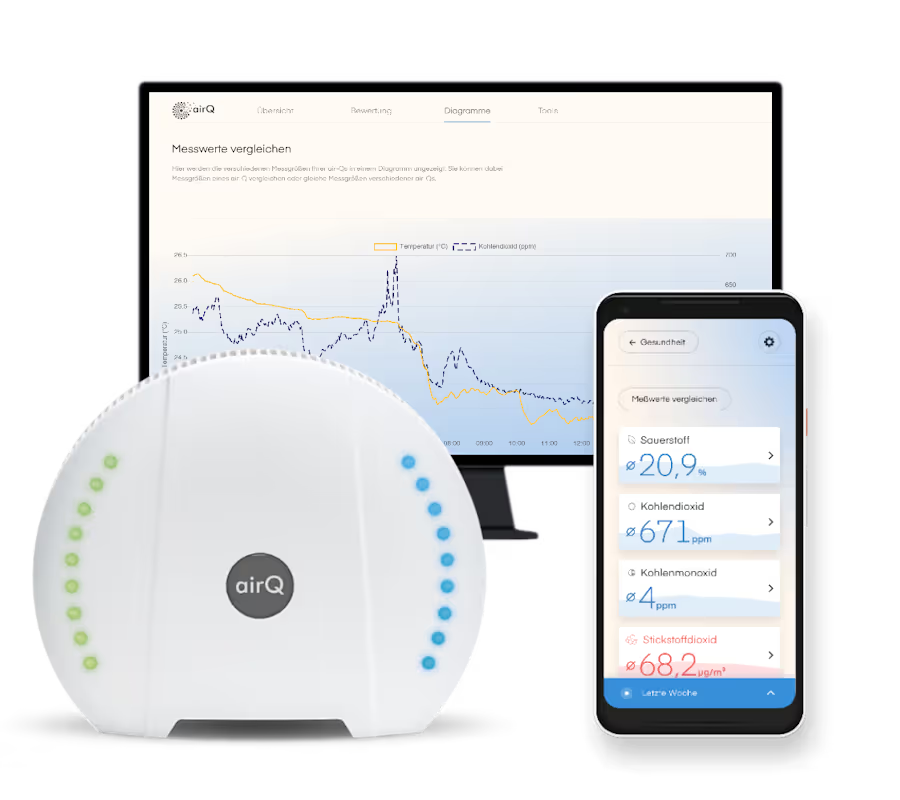
Toutes les valeurs mesurées peuvent être consultées et analysées via l’application smartphone air-Q. Rien n’échappe ainsi à votre attention, car les capteurs utilisés dans l’air-Q mesurent avec un taux d’échantillonnage inférieur à deux secondes — donc vraiment en temps réel. L’air-Q est en outre connectable et fonctionne avec les standards courants de la maison connectée. Grâce aux interfaces de données ouvertes, il n’y a aucune limite pour des analyses personnelles plus approfondies et des connexions à votre maison intelligente.
