
Volatile Organic Compounds (VOCs)
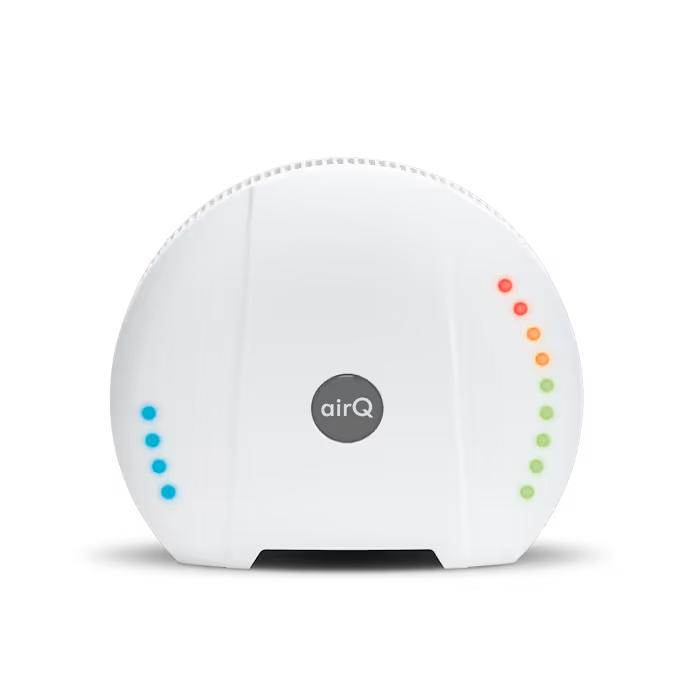
air-Q with a sensor for Volatile Organic Compounds
Description:
The English abbreviation VOC (Volatile Organic Compounds) refers to a group of carbon-containing substances that evaporate at low temperatures or are already in a gaseous state at room temperature. These “volatile organic compounds” are further divided into two subgroups. VVOCs (Very Volatile Organic Compounds) refer to highly volatile substances that often have a strong odor. Less volatile organic compounds are called SVOCs (Semi-Volatile Organic Compounds).
TVOC (Total Volatile Organic Compounds)—that is, the totality of these substances—have boiling points ranging from 50 °C to 250 °C. The time it takes for them to dissipate can range from 10 days to as long as 3 years.
Among the best-known examples of VOCs are formaldehyde and solvents such as toluene.
Since these are organic compounds, they can be found in all areas of life and, in most cases, are harmless to living beings. However, high concentrations indoors can significantly impair well-being.
VOC limit values:
To date, Germany has only established legal regulations setting limit values for workstations that are particularly exposed in production processes. However, for health and safety reasons, the Federal Environment Agency has since issued recommendations regarding the presence of VOCs. The guideline values cover several levels, ranging from hygienically harmless (less than 1 mg/m³ – less than 150 ppb) to hygienically noticeable (between 1 and 3 mg/m³ – 150 to 1,300 ppb) and hygienically concerning (between 3 and 10 mg/m³ – 1,300 to 4,000 ppb) to hygienically unacceptable (more than 10 mg/m³ – more than 1,500 to 4,000 ppb). In addition, guideline values have been established for individual gases in the VOC group.
Many legally relevant sources specify mg/m³ as the unit. However, what is actually measured is a mixture of numerous substances with different molecular weights, whose volumetric proportion in the air is expressed in ppb (parts per billion) or ppm (parts per million). This discrepancy results in conversion factors for substances with low and high molecular weights.
| Denomination | VOC Limit Values |
| Federal Environment Agency - hygienically safe | <1 mg/m³ – menos de 150 a 400 ppb (partes por billón) |
| Federal Environment Office - Remarkable in Terms of Hygiene | 1 to 3 mg/m³ – 400 to 1,300 ppb |
| Federal Environment Agency - a health concern | 3 to 10 mg/m³ – 1,300 to 4,000 ppb |
| Federal Environment Agency - Unsanitary and Unacceptable | >10 mg/m³ – more than 4,000 ppb |
Consequences of a concentration that is too high:
A high concentration of VOCs may initially manifest as an impaired sense of smell and taste or irritation of the eyes or mucous membranes. Other noticeable effects include difficulty concentrating, fatigue, dry skin (which can lead to eczema), and headaches. These symptoms are also referred to as “sick building syndrome” and describe acute exposure. The higher the concentration of VOCs in indoor air, the more pronounced the effects on the sense of smell and irritation of the mucous membranes.
The toxicity of each substance varies widely. However, scientists are concerned about chronic effects resulting from prolonged exposure. These include carcinogenic, mutagenic, and reproductive toxic effects.
Doctors have also observed a link between VOCs and an increase in allergic reactions, especially among infants and young children.
So far, however, a detailed scientific study is still lacking for many VOCs.

Source:
In the formation of VOCs, a distinction is made between biogenic (i.e., natural) and anthropogenic (i.e., human-caused) sources. Natural causes include not only the release of organic compounds through the metabolism of all living organisms, but also putrefaction and other biological decomposition processes. Reactions involving natural materials, such as wood or oils, also contribute to the accumulation of VOCs in the air we breathe.
Synthetic sources of VOCs include emissions from numerous building materials (varnishes, paints, carpets, insulation, etc.), as well as the use of solvents, cleaning products, and cosmetics. Combustion processes—such as tobacco smoke, fireplaces and stoves, and cooking—can also contribute to the accumulation of VOCs indoors.
VOC Sensor: Precise Measurement with air-Q
A VOC sensor is an indispensable tool for monitoring indoor air quality, as it detects volatile organic compounds (VOCs) that can be released from everyday materials and products. These compounds have the potential to harm health and degrade indoor air quality. This is where air-Q’s advanced devices come into play.
Our air-Q devices are specially designed to measure VOCs with the highest precision. Thanks to advanced sensor technology, they provide detailed information about air composition and help you detect potential hazards early on. air-Q’s VOC sensors not only provide accurate measurement data but also come with an easy-to-use app that allows you to monitor and analyze air quality at all times.
Trust air-Q to ensure that your indoor air is clean and safe. Our VOC sensors are the ideal choice for anyone who wants to protect their health and ensure an optimal indoor climate. Discover the combination of innovation and reliability with air-Q—your top choice for measuring VOCs.
Sensor used:
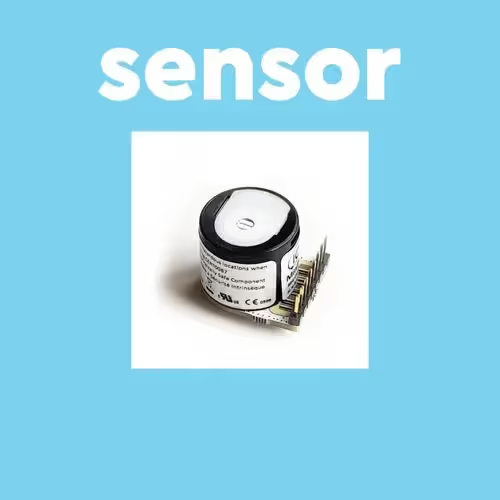
Volatile organic compounds are measured using a resistive sensor. The molecules that “adhere” to the sensor’s surface cause a change in the sensor’s electrical resistance. The advantage of our sensor is that the manufacturer individually calibrates its sensitivity, and it has very low cross-sensitivity to temperature and humidity.
Cross-sensitivities are the main (desired) characteristic of this measurement principle. The VOC sensor is calibrated with alcohol (ethanol), but it also reacts to aldehydes, ketones, hydrogen, methane, and others—making it a true all-rounder.
An additional special VOC PID sensor enables even better measurement results. This very high-quality sensor uses a different measurement method based on ionization. The current generated in this way can be measured.
VOC Measurement:
The air-Q air analyzer, a particularly powerful and comprehensive indoor air quality measurement device, is also equipped with a sensor capable of measuring VOCs, or volatile organic compounds.
You'll find a lot of information about the measuring device's technology here. The air-Q can be ordered from the air-Q store.
More measured values / sensors