
Nitrogen dioxide (NO₂)
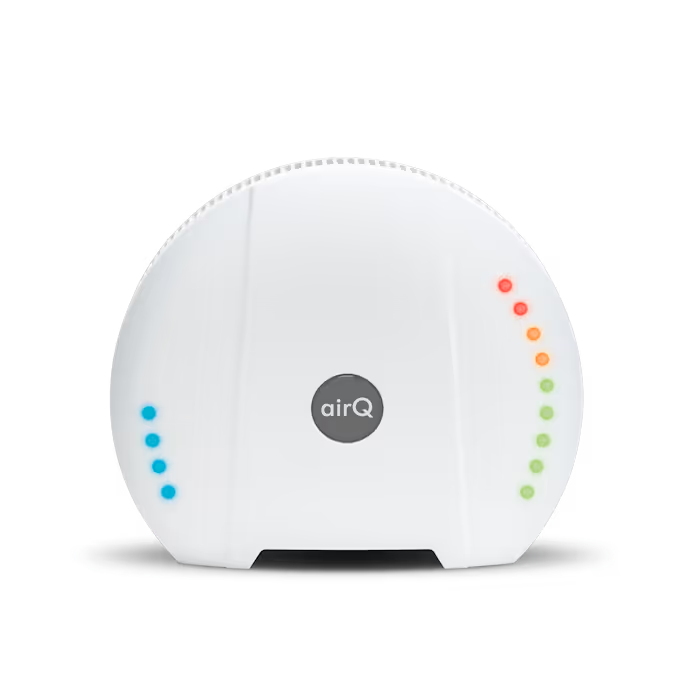
air-Q with a nitrogen dioxide sensor

Description:
This reddish-brown gas is a strong oxidizing agent and highly soluble in water. Since it is also considered highly toxic and extremely corrosive, extreme caution is required when handling NO₂.
Nitrogen dioxide is primarily used in the production of nitric acid. Through the combination of two NO₂ molecules (dimerization), it also serves as an oxidizing agent in rocket technology and in the production of ammonium nitrate. In addition, nitrogen dioxide is used as a nonaqueous solvent, as well as in the manufacture of addition compounds with metals. Nitrogen dioxide is heavier than air and accumulates at ground level.
Limit values for nitrogen dioxide (NO₂):
To date, different limit values have been applied to outdoor air and indoor spaces. For a one-hour period, the European Union has set a maximum limit of 200 µg/m³, which may not be exceeded more than 18 times per year. If the binding annual limit value of 400 μg/m³ is exceeded for three hours at several representative locations in the relevant region, appropriate reduction measures must be taken immediately. This limit value and the recommended measures are still under discussion at the WHO, as simultaneous exposure to other pollutants makes it impossible to establish an unequivocal causal relationship.
The Committee on Indoor Air Quality Guidelines (AIR), established by the Federal Environment Agency, now recommends setting the weekly average concentration for indoor air at 40 µg/m³ as well. However, the one-hour guideline value of 80 µg/m³ and the short-term danger threshold of 250 µg/m³ remain in effect. If this level is exceeded, immediate action must be taken.
The occupational exposure limit for NO₂ has been set at 950 µg/m³. This limit must be maintained over an eight-hour period. During a shift, it may be briefly exceeded up to four times the limit. This limit applies specifically to workers exposed to high levels of nitrogen dioxide in the workplace.
| Denomination | EU Outdoor Air Limit Values | Occupational Exposure Limits | Interior Guidelines |
| Long-Term Investments | 40 µg/m³ | - | 40 µg/m³ |
| Short-term securities | 1-hour average emission limit value: 200 µg/m³, 3-hour average alarm threshold: 400 µg/m³ |
- | Average 1-hour precautionary level: 80 µg/m³, average 1-hour hazard level: 250 µg/m³ |
| Work Shift | - | 950 µg/m³ | - |
Consequences of a concentration that is too high:
Inhaling NO₂ causes the bronchi to constrict. For this reason, patients with bronchial asthma or chronic bronchitis are particularly sensitive to high levels of nitrogen dioxide.
Nitrogen dioxide, which is highly toxic, can only be detected by its characteristic pungent odor at high concentrations. However, even a small amount of NO₂ in the air we breathe can cause dizziness and headaches. Higher concentrations of nitrogen dioxide can lead to difficulty breathing and fluid buildup in the lungs (pulmonary edema). These carry the risk of chronic lung damage, respiratory tract irritation, or chest pain, and in the worst-case scenario, can be fatal.
Other long-term health effects of high exposure to nitrogen dioxide are still being studied. These include cardiovascular disease, diabetes mellitus, and immune system disorders. There is also evidence of reduced fertility.
Sources of NO₂:
The combustion of fossil fuels (primarily coal, natural gas, and petroleum) also produces nitrogen dioxide. Thus, NO₂ is emitted through the exhaust gases of vehicles and aircraft, coal- and gas-fired power plants, as well as various heating boilers. Indoors, nitrogen dioxide is released from open flames (stoves, fireplaces, candles, etc.) and tobacco smoke.
Nitrogen dioxide is also produced during paper manufacturing. In addition, there are natural sources of NO₂. These include not only nitrogen dioxide present in the atmosphere but also microbiological transformation processes in the soil.
Sensor used:
Nitrogen dioxide is measured using an electrochemical sensor. The NO₂ molecules that “adhere” to the sensor’s surface cause a small current to flow through the sensor. The advantage of our sensor is that the manufacturer individually calibrates its sensitivity, and it also has an exceptionally long service life and very low cross-sensitivity.
The sensor we use exhibits slight cross-sensitivity to ozone (O₃). As a result, it also reacts slightly to this gas and thus shows a small deviation, even when NO₂ is not present.
Measurement of nitrogen dioxide:
As a particularly powerful and comprehensive air analyzer, the air-Q also features a sensor capable of measuring nitrogen dioxide in indoor air. You can find a wealth of information about the air-Q's technology here. You can order the air-Q from the online store.
More measured values / sensors