
Ruido (LP)
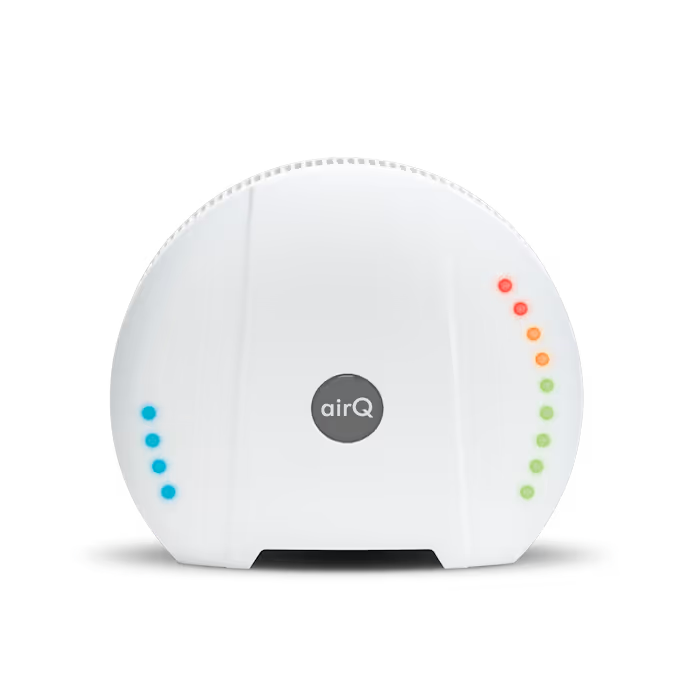
air-Q with a noise sensor
Description:
The vibration of the air generated by sound is measurable and is called sound pressure level. The human ear can perceive sound pressure in a range from 20 µPa to 200 Pa. Sound intensity is measured in decibels (dB).
The main source of noise in Europe is traffic noise from road, air, and rail transportation. As a result, about 40% of people in European countries are exposed to road traffic noise exceeding 55 dB (decibels).
The noise value indicates the maximum volume measured during the last two seconds. For long-term recording, the average of the values measured over two minutes is stored.
Noise limits:
The Federal Law on Protection Against Noise (TA Lärm) establishes maximum noise levels for indoor spaces (25 dB at night, 35 dB during the day). Outdoors, different limits apply depending on the zone. In spa and recreational areas, the limits are 45 dB (day) and 35 dB (night); in purely residential areas, 50 dB (day) and 35 dB (night); in mixed-use areas, 60 dB (day) and 45 dB (night); and in industrial areas, 65 dB (day) and 50 dB (night).
To prevent health problems, the WHO sometimes sets stricter recommendations for the maximum volume of certain noise sources. Thus, for prolonged noise exposure, the limits are 40 dB (night) and 65 dB (day). For road traffic noise, the recommendation is a maximum of 53 dB (day) and 45 dB (night); for rail traffic, 54 dB (day) and 44 dB (night); and for air traffic, a maximum of 45 dB (day) and 40 dB (night). According to the WHO, the noise level caused by wind turbines should be less than 45 dB during the day. In general, at the same sound pressure level, noise is perceived as more or less disturbing depending on its source: rail noise, for example, is perceived as the least disruptive to sleep, and aircraft noise as the most disruptive.
The Regulation on Protection Against Noise and Vibrations in the Workplace (LärmVibrationsArbSchV) applies to noise protection in the workplace. It establishes different limit values depending on the type of activity, the duration, and the specific location of noise exposure or the volume of brief noise events.
| Denomination | Noise Limit Values |
| Federal Act on Protection Against Environmental Pollution (TA Lärm) — Interior | Day: 35 dB Night: 25 dB |
| Federal Act on Protection Against Environmental Pollution (TA Lärm) — Thermal and Recreational Areas | Day 45 dB Night 35 dB |
| Federal Act on Protection Against Environmental Pollution (TA Lärm) — Purely Residential Areas | Day: 50 dB Night: 35 dB |
| Federal Act on Protection Against Environmental Pollution (TA Lärm) — Mixed-Use Zones | Day: 60 dB Night: 45 dB |
| WHO Recommendation for Wind Turbines Near Residential Areas | Day 45 dB |
Consequences of excessive noise:
Loud sounds and constant noise place a heavy strain on the ear. Noise causes permanent damage to the hair cells in the inner ear, which limits hearing. Since these hair cells do not regenerate, the damage caused by noise is irreversible and ultimately leads to hearing loss. Temporary or even chronic tinnitus may also occur.
As a psychosocial stressor, exposure to noise can also significantly impair well-being and, consequently, quality of life. When sounds are perceived as a nuisance, they lead to dissatisfaction and irritability. Since communication and attention are affected, performance is impaired. Sleep disturbances can occur, especially at night. Noise can also trigger mental health conditions.
Physical stress responses to noise affect the entire body, the nervous system, and the endocrine system. Among other things, this causes changes in blood pressure and heart rate, and affects lipid levels, blood sugar, and blood clotting. Impaired circulatory and metabolic regulation can lead to cardiovascular disease or atherosclerosis.
Source of the noise:
In residential and work environments, air conditioners, ventilation systems, and various machines and appliances are often sources of noise. External factors include traffic noise, construction, and other public works, as well as sporting and cultural events. Schools, daycare centers, public squares, animals, and hospitality establishments also contribute to noise levels.
The assessment of when a sound is perceived as noise depends on a wide variety of factors (known as moderators). These include the distance from and visibility of the sound source, as well as the current focus on or importance attached to the issue of noise in public perception. Subjective factors also play a role, such as individual sensitivity to noise, age, the type of activity, and the location where one is staying.
Sensor used:
Noise is measured in the air-Q using an RMS converter. A microphone transmits vibrations to an RMS converter, which generates a voltage level based on the incoming power that can be converted into a decibel value. The advantage of our sensor is that it does not record any audio and actually measures only sound pressure. As a result, the noise sensor is considerably more accurate than various smartphone apps that simulate this level of precision. The sensor continuously records a noise value, with the peak value transmitted every two seconds as live data. In the historical data, the noise value is averaged over a two-minute period.
The small fan in the fine-particle sensor built into the air-Q generates a slight amount of noise on its own; however, this noise is filtered out and is no longer detectable in the air-Q's night mode (fan off).
Measure noise, sound level, and sound intensity:
Measure noise, sound levels, and sound intensity, as well as indoor air pollutants in your office or home in real time, with the air-Q air analyzer, available for order here.
More measured values / sensors