
Oxygen (O₂)
air-Q with an oxygen sensor
Description:
Almost all living animals need oxygen to survive. It is absorbed through respiration or, when dissolved in water, through resorption. However, at high concentrations, oxygen is toxic to most living organisms.
All combustion processes, as well as corrosion processes, occur with the involvement of O₂.
In addition to its medical uses, it is of great importance to the metallurgical industry, since oxygen can form compounds with almost all elements. Furthermore, oxygen plays a role in many combustion and corrosion processes.
Oxygen limit values:
In Germany, there are no legal limit values. Potential harm caused by oxygen depends primarily on pressure. The DGUV 113-004 occupational safety standard sets a limit of 17% oxygen.
The air exhaled by a person still contains approximately 16% oxygen. The oxygen concentration of the air previously inhaled is, on average, approximately 21%.
Even a 100% oxygen concentration—such as that required, for example, for ventilating patients—can cause brain damage in the medium term.
| Denomination | Oxygen Limit Values |
| DGUV Standard 113-004 for Work in Silos and Confined Spaces | 17 % |
Consequences of O₂ concentrations that are too high or too low:
An insufficient supply of oxygen affects the body. If the oxygen content of the air drops below 17%, the first signs of fatigue appear. In addition, the error rate increases in visual tasks and logical reasoning. In such cases, longer reaction times can be expected.
A significantly greater reduction in the oxygen content of the air we breathe also causes symptoms of acute mountain sickness. These include headaches, fatigue, and loss of appetite, as well as nausea and dizziness. In severe cases, cerebral and pulmonary edema may develop. At oxygen concentrations below 13 percent, serious and irreversible damage can occur, which may even lead to death by asphyxiation.
The risk of oxygen toxicity exists only when O₂ is present at a partial pressure that significantly exceeds normal atmospheric pressure. This is particularly relevant for divers. Symptoms include, in addition to rapid and shallow breathing, phenomena such as visual flashes, muscle contractions, and auditory hallucinations. Nausea and dizziness may also occur, potentially leading to loss of consciousness and seizures similar to epilepsy.
In chronic lung diseases with elevated partial pressure of CO₂, such as COPD, oxygen ventilation can have serious consequences for patients. A sudden increase in oxygen supply can, under certain circumstances, cause respiratory arrest.
Source of O₂:
The Earth’s crust alone is composed of 48.9% oxygen. In the Earth’s mantle, the proportion is approximately 30%. On Earth as a whole, only iron is more abundant. However, this oxygen is chemically bound, not in the form of breathable gas. In the early days of the Earth, cyanobacteria released oxygen into the atmosphere as a byproduct of their photosynthesis over a period of more than a billion years, thereby generating the free oxygen that today forms the basis of much of life.
Plants release oxygen during photosynthesis. This is a biochemical reaction triggered by sunlight, through which the plant replenishes its own energy reserves using CO₂ and water, releasing the excess oxygen.
Sensor used:
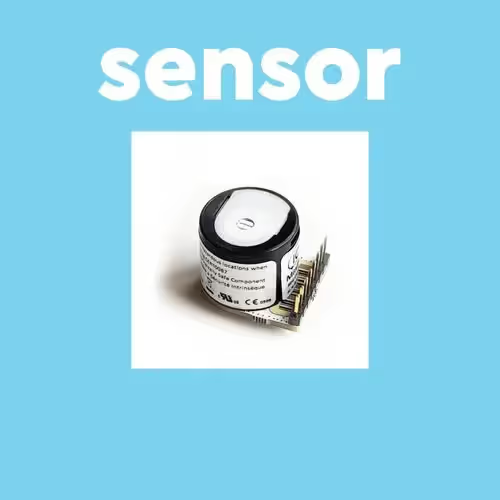
Oxygen is measured using a sensor based on optical fluorescence. The advantage of this principle is its long service life compared to an electrochemical sensor, as well as its lower cost. There are no disadvantages. The sensor we use has no known cross-sensitivity with other gases.
Measuring oxygen:
With the air-Q measuring device, you can measure oxygen as well as all other relevant components of indoor air, such as carbon monoxide. As a particularly powerful and comprehensive device, the air-Q air analyzer features sensor technology capable of measuring the O₂ content of indoor air.
You can find more information about the technology here. You can order the air-Q from the online store.
More measured values / sensors