
Carbon dioxide (CO₂)
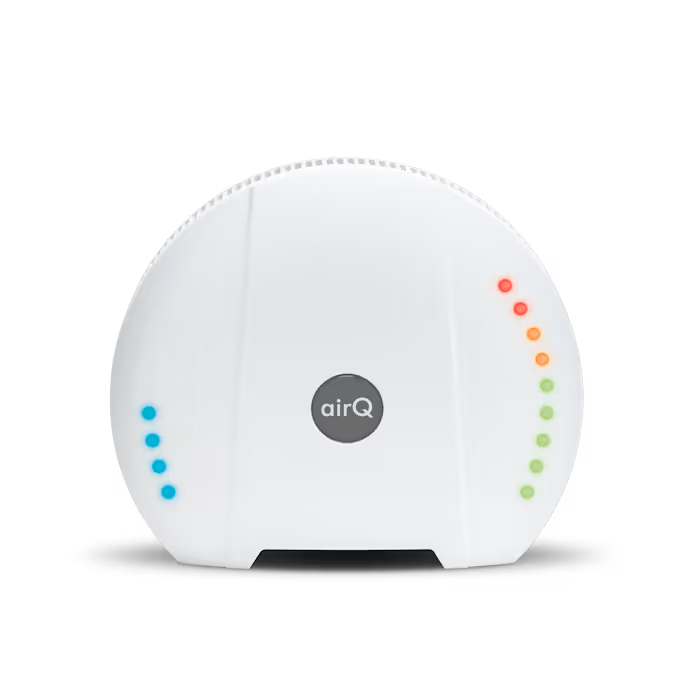
air-Q with a carbon dioxide sensor


Description of carbon dioxide:
Carbon dioxide is odorless at low concentrations. At high concentrations, this greenhouse gas gives off a pungent, acidic odor that is also detectable by humans. CO₂, for example, is heavier than oxygen and accumulates on the ground and in low-lying areas.
Throughout Earth's history, the proportion of carbon dioxide in the Earth's atmosphere has fluctuated greatly. The earliest measured CO₂ levels, dating back 500 million years, indicate a CO₂ concentration of approximately 8,000 ppm (parts per million). For a wide variety of chemical, biological, and physical reasons, this concentration steadily decreased to less than 2,000 ppm. For at least 800,000 years, the concentration of carbon dioxide remained below 300 ppm. Particularly with industrialization and the associated burning of fossil fuels, the CO₂ concentration began to rise again for the first time, reaching its current level of up to 415 ppm.
Carbon dioxide limit values:
The concentration of carbon dioxide in breathable air is currently approximately 415 ppm (equivalent to 0.04% of the air). The air exhaled by a person has a CO₂ content of approximately 40,000 ppm. Consequently, in unventilated bedrooms, classrooms, or crowded meeting rooms, concentrations of up to 5,000 ppm can be measured quickly.
And these high concentrations of carbon dioxide are harmful to concentration, performance, and overall health.
For this reason, the Federal Environment Agency now recommends letting fresh air from outside into the room once CO₂ levels exceed 1,000 ppm. The so-called maximum workplace concentration, or MAK value, is set at 9,100 mg/m³ (equivalent to nearly 5,000 ppm). The DIN 1946-2 standard, which is no longer in effect, specified a limit value of 1,500 ppm.
| Denomination | Carbon Dioxide Limit Values |
| Recommendation from the Federal Environment Agency | 1,000 ppm |
| DIN 1946-2 limit value for good air quality | 1,500 ppm |
| MAK Value for the Workstation | 5,000 ppm |
Consequences of excessively high CO₂ concentrations:
It has been shown that CO₂ concentrations above 1,000 ppm lead to more mistakes at work. This can happen, for example, due to a lack of concentration or headaches when doing calculations, spelling, or looking for spelling errors while proofreading.
If the carbon dioxide concentration reaches 2,000 ppm, a drop in concentration and fatigue may be observed. At concentrations of 5,000 ppm or higher, a significant decline in performance and the onset of headaches can be expected.
The problem is that symptoms such as difficulty concentrating or headaches appear long before the indoor air is consciously perceived as poor.
As the CO₂ concentration increases, the respiratory volume per minute rises continuously and can even become fatal. A carbon dioxide concentration of approximately 80,000 ppm causes respiratory distress and, after 30 to 60 minutes, death.
Sources of Carbon Dioxide
Carbon dioxide is formed during the complete combustion of carbon-containing substances, such as plant matter and petroleum (for example, in the form of fuel), as well as in the bodies of living organisms as a product of cellular respiration. Incomplete combustion, on the other hand, produces carbon monoxide.
Indoors, in addition to people (and possibly animals) who breathe, combustion processes—such as gas stoves, oil/wood/coal/gas stoves, candles, tobacco products, etc.—are the main sources of large amounts of CO₂. These are typically gas stoves, candles, cigarettes, and cigars, or stoves that burn oil, wood, coal, or gas. CO₂ is also released, to a lesser extent, by carbonated beverages.
Sensor used:
Carbon dioxide is measured using an optical sensor. This sensor is based on the principle of infrared absorption. The CO₂ molecule absorbs certain wavelengths of infrared radiation. This is, in fact, also the reason for the greenhouse effect, since this thermal radiation cannot escape from Earth. The sensor measures the intensity of this absorption. To achieve maximum accuracy, the intensity of the infrared LED is also monitored using a second measurement beam. The advantage of this principle over single-beam measurement methods is its high accuracy. It has no disadvantages. The sensor we use has no known cross-sensitivity to other gases.
Measure carbon dioxide:
Measure carbon dioxide and indoor air pollutants in your office or home in real time with the air-Q air analyzer, available for order here.
More measured values / sensors