
Atmospheric pressure (p)
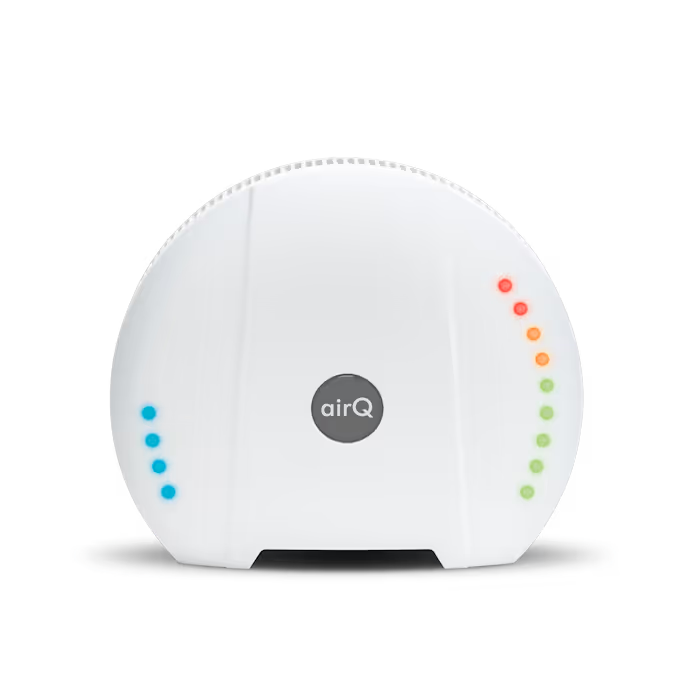
air-Q with an atmospheric pressure sensor
Description:
Atmospheric pressure is defined as the compression—that is, the densification—of air.
Changes in atmospheric pressure are caused by various complex atmospheric processes, among which the heating of air masses by solar radiation is the primary factor. In addition, the Earth’s rotation plays a decisive role. Atmospheric pressure also decreases in a clearly measurable way as altitude above sea level increases.
At sea level, the average atmospheric pressure is assumed to be 101,325 Pa (pascals). This standard value can also be expressed as 1 bar.
Atmospheric pressure limits:
Researchers estimate that variations in atmospheric pressure with an amplitude of between 0.3 and 0.5 hPa have effects on blood pressure, circulation, and concentration.
With regard to overpressure or underpressure, occupational safety measures are implemented. If the value falls below the normal level, a person is exposed to underpressure. If the value drops below 0.73 hPa, the type and duration of the activity must be adjusted for health reasons.
Excessive pressure can cause health problems even with a pressure increase of just 0.1 hPa above the normal value. For this reason, workers under the age of 18 and over the age of 50 may not work under these conditions, or may do so only with special authorization. Pregnant women, nursing mothers, and people with acute or chronic illnesses are also prohibited from working under overpressure. When overpressure exceeds 3.6 hPa, work may be performed only with special authorization from the government.
| Denomination | Atmospheric Pressure Limit Values |
| without defined limit values | - |
Consequences of blood pressure that is too high or too low:
Atmospheric pressure is not the sole factor affecting health and well-being; rather, it is one component of atmospheric environmental conditions. In this context, scientists distinguish three levels of meteorological influences: physiological and psychological.
Everyone falls into at least the "weather-sensitive" category—that is, they are, for example, in a better mood when the weather is pleasant and sunny than when it is rainy and cold.
People whose nervous systems react to changes in atmospheric pressure and temperature are considered “weather-sensitive.” This lowers their overall stimulus threshold while increasing their perception of pain. Typical symptoms include headaches, fatigue, lethargy, exhaustion, and difficulties concentrating and sleeping.
People are described as “weather-sensitive” when changes in the weather exacerbate existing conditions or trigger pain from old injuries (such as bone fractures). This primarily affects patients with chronic respiratory or cardiovascular diseases, atherosclerosis, or rheumatism. People who suffer from chronic pain, migraines, or allergies also often experience a worsening of their symptoms with changes in the weather. In addition, mental health conditions can be exacerbated in this context.
In addition, it should be noted that as pressure increases, the gases contained in the air (especially nitrogen) are absorbed to a greater extent by the body.
Source:
Atmospheric pressure is generated because air—driven by Earth's gravity—tends to flow toward the center of the Earth but is held back by the Earth's surface.
Changes in atmospheric pressure result from the constant movement of air masses in the atmosphere. A high-pressure area occurs when colder air masses move over warmer ones, thereby increasing the pressure of the air masses below. The air, heated by the increased pressure, expands and escapes. To replace it, air flows down from the upper layers, where it is heated.
When warm air masses rise and spread out in the atmosphere, atmospheric pressure at the surface decreases and a low-pressure area forms. The formation of a low-pressure area is often accompanied by a sharp drop in pressure, which can cause health problems in people who are sensitive to or reactive to weather changes.
Sensor used:
Atmospheric pressure is measured in the air-Q using a high-precision, high-resolution sensor. This sensor records atmospheric pressure more than 30 times per second. As a result, the sensor is even capable of detecting the slightest fluctuations in atmospheric pressure that occur when windows and doors are opened and closed.
Measuring atmospheric pressure:
The air-Q air analyzer can measure atmospheric pressure in real time and comprehensively analyze indoor air and air quality by measuring a total of 14 substances and groups of substances (including pollutants such as carbon monoxide). You can order the device here.
More measured values / sensors