
Formaldehyde (CH₂O)
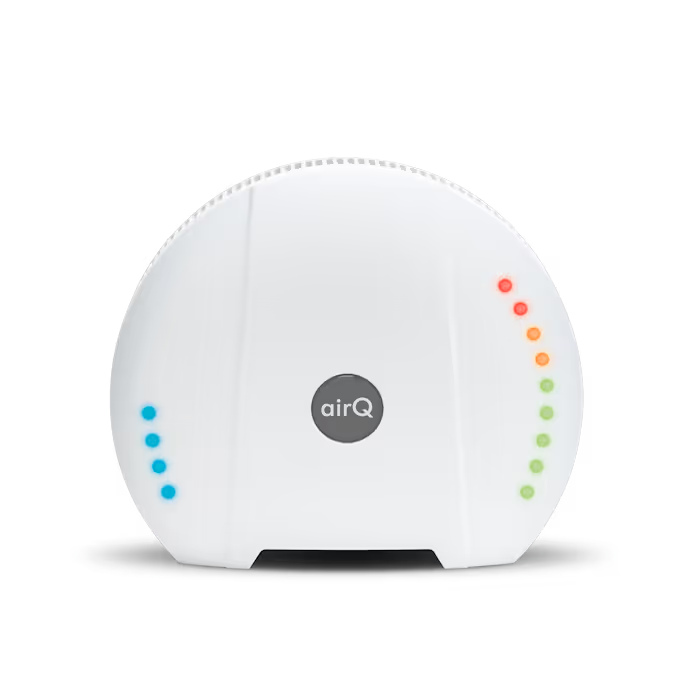
air-Q with a formaldehyde sensor

Description:
Formaldehyde (CH₂O) is a colorless substance with a pungent odor that is gaseous at room temperature. Formaldehyde was originally used as a preservative. As one of the most important organic commodities in the chemical industry, demand for it increased dramatically with the discovery of plastics.
According to the European Union, formaldehyde can cause cancer or increase its incidence.
Today, formaldehyde is an important raw material for many chemical compounds, such as adhesives and plastics. It is released when these materials are burned. CH₂O is highly soluble in water. The aqueous solution is called formalin and is used as a preservative and disinfectant.
In the past, many wood products were heavily treated with this substance, such as particleboard and plywood. These materials regularly release formaldehyde. Modern adhesives largely do not contain it.
Formaldehyde limit values:
The Federal Institute for Risk Assessment (BfR) has set the tolerable concentration of CH₂O at 0.1 ppm (equivalent to 124 µg/m³). The World Health Organization (WHO) recommends a lower value of 0.08 ppm (0.1 mg/m³). A MAK value (maximum workplace concentration) of 0.3 ppm (0.37 mg/m³) applies. This MAK value will be replaced in the future by a lower occupational exposure limit (AGW) (as of January 2020).
| Denomination | Formaldehyde Limit Values |
| Federal Institute for Risk Assessment (BfR) | 0.1 ppm (or 124 µg/m³) |
| WHO Recommendation | 0.08 ppm (or approximately 100 µg/m³) |
| MAK (maximum workplace concentration) | 0.3 ppm (or 370 µg/m³) |
Source of formaldehyde:
Formaldehyde is produced, for example, in mammalian cells as an intermediate product of metabolism. Mammalian blood consistently contains between two and three milligrams of formaldehyde per liter. In humans, too, about 50 grams of this substance are produced daily, and it breaks down rapidly. With each breath, a person exhales approximately between 0.001 and 0.01 mg/m³.
Formaldehyde occurs naturally in fruits such as apples and grapes, so it is also absorbed through our daily diet. In addition, it is a natural component of wood and is released in small amounts into the surrounding air.
Formaldehyde is also produced during incomplete combustion and other oxidation processes involving longer-chain organic substances, such as methane and volatile organic compounds (VOCs). It is also produced when smoking.
Formaldehyde is also formed in the atmosphere through photooxidation (of methane) and has a concentration there of approximately 1 ppb (parts per billion).
Industrially, CH₂O is produced through a process known as the catalytic oxidation of methanol.
Consequences of exposure:
Formaldehyde can cause allergies, irritation of the respiratory tract or eyes, as well as skin irritation in the event of direct contact with liquid solutions. Concentrations of 30 mg/m³ or higher are life-threatening. The substance can affect memory and the ability to concentrate, as well as cause sleep disturbances.
When formaldehyde or its precursor, methanol—which is present in low-quality alcoholic beverages—is ingested, the methanol is converted via formaldehyde into formic acid. Formaldehyde itself easily destroys the proteins in the retina, which can lead to blindness.
Formaldehyde is classified as a carcinogen and a mutagen.
Formaldehyde forms explosive mixtures with air (oxygen) at a concentration of 7% by volume (87 g/m³) (= lower explosive limit (LEL)).

Sensor used:
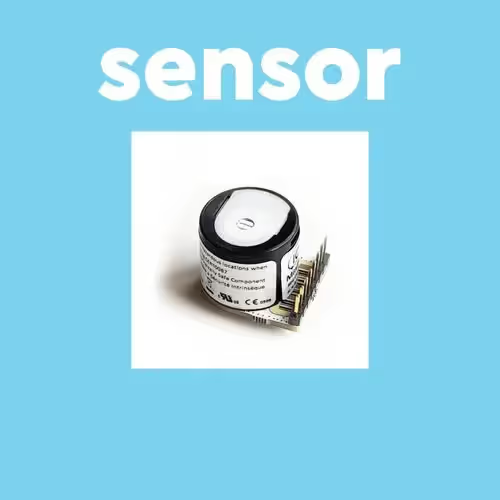
Formaldehyde is measured using an electrochemical sensor. The molecules that “bind” to the sensor’s surface cause a change in the sensor’s electrical current. The advantage of our sensor is the individual sensitivity calibration performed by the manufacturer and its very low cross-sensitivity to temperature and humidity.
Formaldehyde Meter
A formaldehyde meter, also known as an HCHO meter, is an important tool for monitoring formaldehyde concentrations in indoor spaces. Formaldehyde is a volatile organic compound found in many household products such as furniture, paints, and adhesives. Prolonged exposure to high levels of formaldehyde can cause health problems such as respiratory diseases and irritation of the mucous membranes. That is why it is essential to regularly check the formaldehyde concentration in your home or office.
A formaldehyde (HCHO) meter like the air-Q Basic Formaldehyde Special allows you to accurately measure formaldehyde levels in the air and ensure they remain within safe limits. Our reliable formaldehyde meter stands out for its accuracy, ease of use, and fast response time.
Using a formaldehyde meter is simple and requires no special technical knowledge. Place the device in the area you want to monitor and follow the rest of the instructions. The air-Q formaldehyde monitor stands out in particular for its ability to analyze the collected data using a computer or smartphone and the accompanying free app. This way, air-Q allows you to continuously monitor and analyze air quality.
By using our device and app, you can take proactive steps to reduce exposure to formaldehyde—for example, by using air purifiers or choosing low-emission materials. This way, you protect not only your own health but also that of your family, and create a safe and pleasant indoor environment. Create a healthy and safe living and working environment.
Measure formaldehyde:
It measures the concentration of formaldehyde and other components and pollutants in indoor air in real time to protect your health and ensure your performance. You can order the air-Q as an air quality monitor here.
More measured values / sensors